

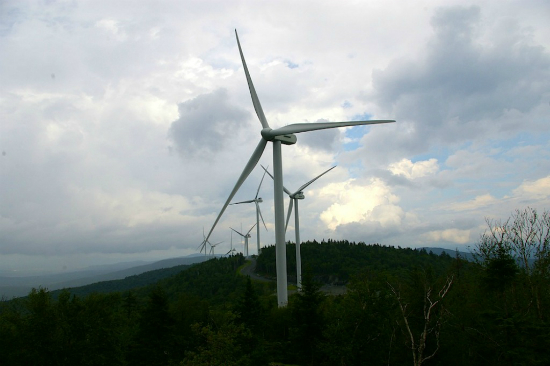
by Tim McQuiston, Vermont Business Magazine Green Mountain Power Corporation will face an August 8 hearing in front of the Public Service Board to determine if any civil penalties should be imposed on violations of noise limits at the Lowell Mountain wind farm last fall and winter. The PSB, in an order dated July 15, concluded that the Lowell Mountain turbines exceeded the limits and therefore GMP was in violation of its Certificate of Public Good.
GMP had argued that it was a two-step sanctioning process, first to determine if there was a violation, which GMP does not dispute, and, second, on whether GMP had a plan to fix the problem, which it does (SEE ORDER BELOW). The PSB stated that, in fact, the violation and remediation are separate issues.
GMP spokesperson Dorothy Schnure told Vermont Business Magazine: "Whether you call it a violation or exceedance, the fact that we were in compliance 99.96 percent of the time and have mechanisms in place to avoid conditions that caused us to slightly exceed the standard for four of the more than 6,000 hours tested shows our absolute commitment to ensure we meet the sound standard."
In fact, in a report released July 17 showed Lowell turbines were below the sound limits for the most recent testing period.
In its order on the "exceedances," as the PSB refers to them, it states: "In today's Order we conclude that the exceedances identified in the Fall Report and Winter Report constitute violations of the Order and CPG that are subject to the imposition of civil penalties under 30 V.S.A. § 30, and will be issuing a Show Cause Order and Notice of Hearing establishing August 8, 2013, as the date for hearing evidence on the imposition of civil penalties for the identified violations."
The PSB went on to say, "We remind GMP that it is under an obligation to operate the Project within the limits established by Condition 39, including cessation of turbine operations if necessary to achieve compliance."
While that is welcome news to opponents of the wind turbines, the PSB declined to impose immediate penalties on GMP as requested by the towns of Albany and Craftsbury ("Albany/Craftsbury"), Lowell Mountains Group, Inc ("LMG") and instead set up the hearing. On the one hand, some of the violations happened before all the turbines were fully operational, while on the other hand, the turbines have been under the noise limits while under full operation.
The PSB stated: "LMG and Albany/Craftsbury assert that the inescapable conclusion is that more violations will occur at higher capacity operations. While it seems reasonable to infer that the identified violations would have exceeded the applicable standard by a greater margin had the Project been operating at a higher capacity at those times, we note that the reports also show other times when the Project was operating at capacity levels above those when the violations occurred, while staying within the applicable noise standard. This suggests that the violations were the result of a number of factors, including meteorological conditions, and not just the number of turbines in operation or the capacity level at which they were operating. That said, as we noted above, GMP must take the steps necessary to ensure compliance with Condition 39, even if that means operating the Project at a reduced capacity when conditions are expected that would result in a violation of the noise standard."
FULL ORDER:
STATE OF VERMONT
PUBLIC SERVICE BOARD
Docket No. 7628
Joint Petition of Green Mountain Power Corporation,
Vermont Electric Cooperative, Inc., and Vermont
Electric Power Company, Inc. for a certificate of public
good, pursuant to 30 V.S.A. Section 248, to construct up
to a 63 MW wind electric generation facility and
associated facilities on Lowell Mountain in Lowell,
Vermont, and the installation or upgrade of
approximately 16.9 miles of transmission line and
associated substations in Lowell, Westfield and Jay,
Vermont
Order entered: 7/15/2013
ORDER RE NOISE MONITORING REPORTS
I. INTRODUCTIONOn May 31, 2011, the Public Service Board ("Board") issued an Order (the "Order") and
Certificate of Public Good ("CPG") in this Docket approving, subject to certain conditions, the
construction and operation of the proposed wind electric generating facility (the "Project").
Among other things, the Order required the Petitioners to make a number of post-certification
compliance filings. Condition 41 of the Order and CPG required Green Mountain Power
Corporation ("GMP") to file with the Board a sound-monitoring plan for comment by the parties
and review and approval by the Board. On May 16, 2012, the Board issued an Order approving
GMP's proposed sound-monitoring plan.1 In accordance with the requirements of the approved
sound-monitoring plan, GMP has conducted and filed reports on two periods of sound
monitoring for the Project. In today's Order we conclude that the exceedances identified in the
Fall Report and Winter Report constitute violations of the Order and CPG that are subject to the
imposition of civil penalties under 30 V.S.A. § 30, and will be issuing a Show Cause Order and
1. Docket 7628, Order of 5/16/12 at 2.
Notice of Hearing establishing August 8, 2013, as the date for hearing evidence on the imposition
of civil penalties for the identified violations. In today's Order we also address the comments
made by Albany and Craftsbury ("Albany/Craftsbury"), Lowell Mountains Group, Inc. ("LMG"),
the Town of Lowell, and the Department of Public Service ("Department").
II. PROCEDURAL HISTORY
On May 16, 2012, the Board issued an Order approving GMP's proposed soundmonitoring
plan, as filed May 3, 2012.2
Consistent with the requirements of the approved plan, GMP has conducted and filed
reports on two periods of noise monitoring, the first taking place between December 6, 2012, and
January 12, 2013 (the "Fall Monitoring Period" and "Fall Report"), and the second taking place
between February 19, 2013, and March 25, 2013 (the "Winter Monitoring Period" and "Winter
Report"). The two reports showed there were a number of times when the Project was operating
at noise levels in excess of the applicable noise standard that was established in the Order and
By memorandum from the Clerk of the Board dated May 10, 2013, the Board invited
comments from the parties in response to the two monitoring reports that GMP had filed.
On May 31, 2013, comments were filed by Albany/Craftsbury.
On June 3, 2013, the Town of Lowell filed comments.
On June 6, 2013, comments were filed by the Department.
On June 12, 2013, comments were filed by LMG.
GMP filed reply comments on June 13, 2013.
III. POSITIONS OF THE PARTIES
Albany/Craftsbury are concerned that both the Fall Report and Winter Report show that
the Project exceeded the applicable sound standard when only a limited number of turbines were
operational, or where a number of turbines were operating below their full capacity. According
to Albany/Craftsbury, this means that future violations are likely once all Project turbines are
2. Docket 7628, Order of 5/16/12 at 2.
operating. Albany/Craftsbury also assert that GMP has not indicated what steps it will take to
address the exceedances identified in the two reports. Albany/Craftsbury recommend that GMP
be required to shut down a sufficient number of turbines to prevent future exceedances when
weather conditions arise that are similar to those at the time the identified exceedances occurred.
Albany/Craftsbury also assert that GMP has failed to properly monitor for low-frequency sound,
and recommend that the Board require indoor testing to confirm that indoor sound levels are not
exceeding the indoor standard established by the CPG and Order. Albany/Craftsbury also
recommend that GMP be required to pay a fine for the identified exceedances, and that in the
event there are future exceedances, the Project, or at least a sufficient number of Project turbines,
be shut down until GMP can ensure the Board that no more exceedances will occur. Lastly,
Albany/Craftsbury recommend that the Board take testimony from area residents to better
understand how noise from the Project is affecting those living nearby.3
LMG is also concerned about the occurrence of exceedances when either not all turbines
are operating or some number of turbines are operating at a low output level. Like
Albany/Craftsbury, LMG believes that this leads to the inescapable conclusion that more
exceedances will occur with the Project operating at a higher capacity in the future. LMG is
critical of at least one instance of microphone placement, contending that it is too close to foliage
and that the data it recorded was therefore contaminated, as well as the unattended nature of the
monitoring which renders certain data unusable in determining compliance with the noise
standard. LMG is also concerned that hub height wind speeds are reported as very low or zero
when turbines are not producing power. According to LMG, this has the effect of obscuring
turbine power levels versus wind speed and turbine performance during noise monitoring. LMG
also requests that GMP be required to conduct indoor testing and asserts that the standard
adopted by the Board in the Order and CPG is insufficient to protect health and safety. LMG
included a number of completed complaint forms from area residents along with its comments.4
The Department asks that the Board clarify its intent with respect to the conditions in the
Order and CPG that impose the actual noise standard as well as the obligation for GMP to take
3. Albany/Craftsbury Comments at 1-2.
4. LMG Comments at 1-10 and attachments.
whatever steps are needed to bring the Project into compliance in the event the noise standard is
exceeded. Specifically, the Department asks the Board to confirm that an exceedance of the
applicable noise standard constitutes a violation of the Order and CPG that is subject to potential
sanctions, even if GMP subsequently takes steps to cure the exceedance. The Department
recommends that no penalties be imposed at this time given the steps GMP is undertaking to
remedy the exceedances identified in the Fall Report and Winter Report. However, if the
remedial steps being undertaken by GMP fail and additional exceedances are identified in
forthcoming sound-monitoring reports, the Department recommends that the Board take the
exceedances identified in the Fall Report and Winter Report into account when considering
penalties for any future exceedances.5
The Town of Lowell states that the majority of Lowell residents support the Project, and
that many residents that live within two miles of the turbines have stated that they either do not
hear the turbines at all, or the sound the turbines produce is difficult to distinguish from the
typical background sounds in a small Vermont community.6
In its responsive comments GMP contends that the concerns expressed by
Albany/Craftsbury and LMG regarding the identified exceedances are misplaced because GMP
must take whatever steps are necessary to operate the Project in compliance with the applicable
noise standard. With respect to Albany/Craftsbury's and LMG's recommendations that GMP be
required to conduct indoor testing, GMP notes that the approved sound-monitoring plan already
has a process in place to determine when indoor testing is required and that it has not yet received
any requests for indoor testing pursuant to that process.7
In response to LMG's concerns about lack of wind speed data when turbines are not
operating, GMP states that wind speed data is developed as part of Supervisory Control and Data
Acquisition ("SCADA") data which is not available when turbines are not in service. GMP also
notes that turbine power levels are zero when turbines are not operating and asserts that LMG
does not explain why the data is needed in order to measure compliance with the noise standard.
5. Department Comments at 1-3.
6. Lowell Comments.
7. GMP Reply Comments at 3.
As to LMG's concern over microphone placement and noise contamination, GMP points out that
the microphone placement was approved by the agreed-upon third-party monitor that oversaw the
first round of noise monitoring, and that the placement of the microphone in question would
actually increase the chance of a false positive due to the presence of potential noise from foliage.
GMP contends that LMG's claim that the existing noise standard is too lenient should be rejected
because such a claim cannot be entertained absent a formal pleading and a demonstration that the
request for relief is timely. Lastly, GMP does not believe the complaint forms filed by LMG are
relevant to a process that is seeking comments on the contents of the Fall Report and Winter
Report.8
With respect to the Albany/Craftsbury comments regarding the lack of low-frequency
noise monitoring and the lack of identifiable remedial actions being taken by GMP to address the
identified exceedances, GMP asserts that Albany/Craftsbury are incorrect. According to GMP,
the sound monitoring data includes frequencies between 20 Hz through 10,000 Hz, which
includes low-frequency sound. GMP states that the reports contain the required summary of the
collected low-frequency data. GMP also states that its remedial actions consist of analyzing the
conditions that led to the exceedance identified in the Fall Report, determining that the violations
identified in the Winter Report may have been caused by unusual snow build-up on the turbine
blades, installing additional meteorological equipment to help forecast unfavorable conditions,
instituting video monitoring of the turbine blades to watch for unfavorable conditions, and
agreeing to institute the Cavanaugh Tocci Associates' ("CTA") recommendation for attended
monitoring. Lastly, with respect to Albany/Craftsbury's recommendation that the Board take
testimony on noise impacts from area residents, GMP states that it is little different from LMG's
inclusion of written complaint forms and should be rejected for the same reasons.9
GMP disagrees with the Department's view that the exceedances identified in the Fall
Report and Winter Report are sanctionable in and of themselves. According to GMP, there must
be non-compliance with a two-step process for there to be a noise-related violation of the Order
and CPG. First, there must be noise in excess of that allowed by the applicable standard. And,
8. GMP Reply Comments at 2-3.
9. GMP Reply Comments at 3-4.
second, GMP must then fail to take remedial actions designed to bring Project operations into
compliance with that standard. Therefore, GMP asserts, there have not yet been any violations of
the Order and CPG because it is taking steps to bring the Project into compliance.10
IV. DISCUSSION
In today's Order we conclude that the exceedances identified in the Fall Report and
Winter Report constitute violations of the Order and CPG that are subject to the imposition of
civil penalties under 30 V.S.A. § 30 and will be issuing a Show Cause Order and Notice of
Hearing establishing August 8, 2013, as the date for hearing evidence on the imposition of civil
penalties for the identified violations. We also address the comments made by
Albany/Craftsbury, LMG, the Town of Lowell and the Department.
1. Exceedances of the noise standard are violations of the Order and CPG
The conditions of the Order and CPG that are relevant to this portion of our discussion
are as follows:
39. The Petitioners shall construct and operate the proposed project so that the
turbines emit no prominent discrete tones pursuant to ANSI standards at the
receptor locations, and project-related sound levels at any existing surrounding
residences do not exceed 45 dBA(exterior)(Leq)(1 hr) or 30 dBA (interior
bedrooms)(Leq)(1 hr).
40. In the event noise from operation of the proposed project exceeds the
maximum allowable levels, the Petitioners shall take all remedial steps necessary
to bring the sound levels produced by the turbine(s) into compliance with
allowable levels, including modification or cessation of turbine(s) operation.11
GMP reads these two separate conditions, each with its own obligations, as a two-step
process to be followed and contends that no sanctionable violation occurs unless GMP fails to
take the remedial steps necessary to bring turbine operations back into compliance once
exceedances of the noise standard have been identified.
10. GMP Reply Comments at 1-2.
11. Docket 7628, Order of 5/31/11 at 165; CPG dated 5/31/11 at 8.
We do not find GMP's reasoning to be persuasive. First, it overlooks the fact that GMP's
obligations with respect to turbine noise are set out in two separate conditions, each with its own
set of requirements. Operation of the turbines in excess of the applicable noise standard is a
violation of Condition 39 of the Order and CPG and therefore subject to sanctions under Section
30. Failure to take remedial steps to bring turbine operations back into compliance is a second,
separate violation of Condition 40 of the Order and CPG subject to additional Section 30
sanctions. Second, GMP's reasoning could lead to repeated operations in excess of the noise
standard established by Condition 39 without sanction, provided GMP subsequently took steps to
bring noise levels back into compliance with Condition 39. Such a scenario, and the potential
for repetitive litigation before the Board over whether a violation had occurred based on the
specific facts of each exceedance, would defeat the purpose of having the bright line standard
created by Condition 39 in the first place. Therefore turbine operation in excess of the noise
standard established by Condition 39, including those times identified in the Fall Report and
Winter Report, constitutes a violation of the Order and CPG that is subject to the imposition of
civil penalties under 30 V.S.A. § 30.
Two parties have made different recommendations for how we should address the
exceedances identified in the Fall Report and Winter Report. First, Albany/Craftsbury
recommend that we impose a civil penalty. However, Albany/Craftsbury do not provide a
specific recommendation for a penalty amount, nor do they provide any analysis in support of a
penalty amount under the factors set forth in 30 V.S.A. § 30(c). The Department recommends
that we not impose a penalty at this time, contending instead that it is appropriate to defer
consideration of penalties given GMP's efforts to remediate the situations that appear to have
given rise to the identified exceedances. In the event future sound monitoring reports indicate
that GMP's remedial efforts have failed and additional exceedances have occurred, the
Department recommends that all violations be considered together at that time with respect to
possible sanctions.
While we understand the Department's recommendation, we are today also issuing a
Show Cause Order and Notice of Hearing to institute proceedings to determine the appropriate
civil penalty for the identified violations. However, given the ongoing nature of the noise
Docket No. 7628 Page 8
monitoring and the expected Spring 2013 report, the contents of that report will also be
considered at the evidentiary hearing on August 8, 2013.12 We are instituting the penalty process
under Section 30 at this time because we are very concerned about the identified exceedances.
GMP's witness presented testimony and exhibits that indicated the Project could be operated
within the sound standard established by the Order and CPG, and yet both the Fall Report and
Winter Report indicate that Project operations have been non-compliant at times. We remind
GMP that it is under an obligation to operate the Project within the limits established by
Condition 39, including cessation of turbine operations if necessary to achieve compliance.
2. Exceedances occurring at less than full operating capacity
A review of the sound monitoring reports does indicate that exceedances occurred at
times when either not all turbines were operating, or when a number of turbines were operating
below their full capacity. This raises the question of what sort of noise levels should reasonably
be expected to occur when the Project is operating at full capacity. LMG and Albany/Craftsbury
assert that the inescapable conclusion is that more violations will occur at higher capacity
operations. While it seems reasonable to infer that the identified violations would have exceeded
the applicable standard by a greater margin had the Project been operating at a higher capacity at
those times, we note that the reports also show other times when the Project was operating at
capacity levels above those when the violations occurred, while staying within the applicable
noise standard. This suggests that the violations were the result of a number of factors, including
meteorological conditions, and not just the number of turbines in operation or the capacity level
at which they were operating. That said, as we noted above, GMP must take the steps necessary
to ensure compliance with Condition 39, even if that means operating the Project at a reduced
capacity when conditions are expected that would result in a violation of the noise standard.
3. Microphone placement
LMG is critical of the placement of microphones at primary locations due to the
proximity of foliage. However, the placement of the microphones was based on professional
judgment to achieve representative results for the site in question, and was approved by CTA, the
12. According to GMP, the spring monitoring period was scheduled for late May, 2013. Winter Report at 9. A
report is due within six weeks of the conclusion of each monitoring period.
Docket No. 7628 Page 9
agreed-upon, third-party, neutral reviewer hired to assess GMP's compliance with the soundmonitoring
requirements in the approved monitoring plan. CTA filed its report on February 19,
2013, and concluded in relevant part that the microphone placement was consistent with the
requirements of the sound-monitoring plan. Additionally, as GMP notes, the proximity of foliage
at a primary monitoring location is more likely to result in a false positive than a false negative
because the primary sound level, that is the sound level which includes both turbine noise and
background noise, would be higher than it would be in the absence of foliage. Under method 2,
where background sound is determined by shutting down turbines, the calculated turbine sound
level would be unaffected since any foliage-induced noise is accounted for in both the primary
and background sound values. Under method 3, where background sound is determined by
placing a microphone on the side of a structure opposite the turbines, the presence of foliage at
the primary location would tend to favor a false positive because the primary level would include
the foliage-induced noise while the background number, which is subtracted out, would not
include that noise.
Given CTA's concurrence in the placement of microphones, we find no merit in LMG's
criticisms.
4. Hub height wind speeds
LMG expresses concerns over the lack of hub height wind speed data for turbines that are
not operating or are operating at very low output levels. GMP points out that hub height wind
speed data is generated as part of SCADA data for the Project and is therefore unavailable when
a turbine is not operating.
LMG has not sufficiently articulated its need for this data in determining whether the
Project is operating in compliance with the noise standard established by Condition 39. When a
turbine is not operating, it is not producing power nor is it contributing to noise levels because its
blades and drive train are not moving.13 Additionally, if this information were available, it might
be useful to GMP for understanding the causes of, and potential remediation for, excessive sound
levels, but LMG does not explain why it would need the information to assist it in a review of
13. We note that there may be some sound related to the passage of wind around the turbine itself.
Docket No. 7628 Page 10
Project compliance with the applicable noise standard. Accordingly, we conclude that no action
is warranted in response to LMG's comments.
5. Unattended monitoring
LMG is concerned that the unattended nature of the monitoring has led to the inability to
rely on certain data to determine compliance, particularly where the background noise readings
are greater than 45 dBA.
LMG's concerns are addressed by the recommendation in the CTA report that short-term
attended monitoring take place at a time when the Project is forecast to be producing maximum
sound power.14 GMP has agreed to implement the recommendation for the Fall 2013 monitoring
period.15
6. Indoor testing
Both LMG and Albany/Craftsbury assert that the Board should require GMP to conduct
indoor testing to ensure compliance with the maximum indoor sound level imposed by Condition
39. We decline to take the requested step because neither LMG nor Albany/Crafstbury has the
authority to grant GMP access to any individual's home, nor can the Board require homeowners
to allow GMP access in order to conduct indoor testing. The approved sound-monitoring plan
already has a process by which GMP may be required to conduct indoor sound monitoring in
response to a request when certain specified conditions are met. To date, GMP has apparently
not received any such requests. However, we are concerned given the violations identified in the
Fall Report and Winter Report and therefore encourage homeowners who believe that they are
entitled to have indoor testing conducted to contact GMP and follow the existing protocol.
7. Low-frequency sound monitoring
Albany/Craftsbury incorrectly assert that GMP has not conducted the required lowfrequency
monitoring. According to the CTA report, with the exception of an instance related to
a problem with the background meter at one location during the Fall Monitoring Period, lowfrequency
sound was sampled at the same rate as other frequencies in the audible range.16
14. CTA Report at 4.
15. Winter Report at 35-36.
16. CTA Report at 3.
8. Remedial measures
Albany/Craftsbury assert that GMP has failed to explain what remedial measures it is
taking to address the identified violations. This is incorrect. GMP has stated that: (1) it is
analyzing the conditions that led to the exceedance identified in the Fall Report; (2) it has
determined that the violations identified in the Winter Report may have been caused by unusual
snow build-up on the turbine blades; (3) it is installing additional meteorological equipment to
help forecast unfavorable conditions; (4) it will institute video monitoring of the turbine blades to
watch for unfavorable conditions; and (5) it will institute the CTA recommendation for attended
monitoring.
Contrary to Albany/Craftsbury's claim, GMP has set forth the steps it intends to
implement to avoid future noise levels in excess of the applicable standard. Whether those steps
are effective, and whether additional measures will be required, will be determined after
additional monitoring is conducted and additional reports are filed.
9. Sufficiency of existing noise standard, additional testimony, complaint forms
As noted above, LMG has challenged the sufficiency of the existing noise standard for
the protection of public health and safety, and submitted a number of written complaint forms
along with its comments. Similarly, Albany/Craftsbury note their earlier testimony in this
proceeding regarding the sufficiency of the noise standard and ask that the Board take testimony
from area residents regarding their experiences related to noise impacts from the Project.
We decline to take any specific action in response to the comments from LMG and
Albany/Craftsbury. The existing noise standard was imposed following a contested case process
in which significant testimony on the subject was prefiled, witnesses were subject to lengthy and
detailed cross-examination, and the parties submitted extensive briefs on this question. To the
extent that LMG and Albany/Craftsbury appear to be asking the Board to change the existing
noise standard, the comments do not provide a sufficient legal basis to reopen the provisions of a
final Board Order issued approximately two years ago.
We do acknowledge that LMG has submitted a number of written noise complaints that
appear to have been collected by the group Vermonters for a Clean Environment. However, we
also note that the Town of Lowell submitted comments which indicate that many of the Lowell
Docket No. 7628 Page 12
residents that live within two miles of the turbines either do not hear any turbine noise at all, or
what they do hear is difficult to distinguish from typical background sounds in the community.
Additionally, the approved sound-monitoring plan contains a complaint procedure for residents
who believe they are experiencing noise levels in excess of the applicable standard to follow.
LMG's comments with their attached complaint forms do not discuss whether any of the
complaining parties have availed themselves of that existing process.
Lastly, because we have determined that the comments filed by LMG and
Albany/Craftsbury do not provide a sufficient legal basis for reopening the evidentiary record for
an examination of the sufficiency of the existing standard, we decline to adopt
Albany/Craftsbury's recommendation that the Board take testimony from area residents regarding
noise impacts from the Project.
SO ORDERED.
Dated at Montpelier, Vermont, this 15th day of July, 2013.
s/James Volz, s/David C. Coen, s/John D. Burke )
PUBLIC SERVICE BOARD OF VERMONT
OFFICE OF THE CLERK
FILED: July 15, 2013
ATTEST: s/Susan M. Hudson
Clerk of the Board
TOP PHOTO of the Lowell Mountain wind farm courtesy of vtdigger.org