

by Tim McQuiston Vermont Business Magazine Vermont state government will have nearly $20 million less to work with in fiscal year 2014, according to two economists charged with forecasting tax revenues. Jeff Carr and Tom Kavet, giving their semi-annual review of state tax receipts, said they expect the General Fund will be down $11.1 million, the Transportation Fund down $5.6 million and the Education Fund down $2.6 million for the fiscal year starting July 1, 2013.
The governor, who gives his budget address to the Legislature Thursday at 2 pm, added, I can assure that we will present a balanced budget (FY 2014) to you tomorrow. It has been the states fiscal mission, and pride, since the second Snelling term in the early 1990s that Vermont balances its budget. Wall Street has responded by giving the state high bond ratings.
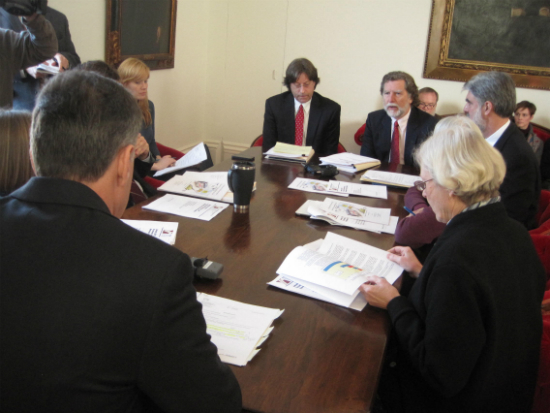
Jeff Carr, left, and Tom Kavet.
Kavet, who is contracted by the Legislature, said of the downwardly revised forecast, Theres been a downshift in the macro-economic forecast. He said both he and Carr, however, did not cut back their projections as much as Moodys Economy.com had, because, they felt, Vermont was in a somewhat stronger position than the nation as a whole.
Among other things, the Vermont unemployment rate, at 5.1 percent, is three points lower than the national rate.
"I think there's still a lot that can go right (with the economy)," Kavet said.
But still, Carr said it's been a slow climb out of the economic downturn.
"So far from the bottom of the great Recession, we're not talking about forecasting upgrades," he said.
Avoiding the so-called fiscal cliff of course helps the cause, he said, because Vermont could have been one of the hardest hit states if the federal government had not come up with a plan to avoid automatic tax hikes and budget cuts.
Europe still creates a "downside" risk for the Us and Vermont economies, as it muddles through its on-going fiscal problems, Kavet said.
Among the minutiae, Kavet noted that the cigarette tax receipts, important especially to the Education fun, were down significantly, though he could not explain why. Perhaps, he said, its a reporting issue. He also showed concern for the Corporate tax, which has been one of the strongest segments of the General Fund revenues this fiscal year.
The Corporate Tax could be very volatile going forward, Kavet said. There are a relatively small number of firms driving these revenues, which could result, he said, in wide swings.
In part, corporation profits have been up as the economy grows, but corporations have been holding their money instead of hiring or investing in new equipment as they wait for the economy to strengthen. While this has created higher profits and taxes, a change in behavior could lead to lower receipts, but which could benefit employment and purchasing.
Along with the reduction in fuel tax receipts, the increase in payroll taxes following the "fiscal cliff" deal will further reduce consumer activity, Kavet said. This could further reduce sales of motor vehicles. Part of the Motor Vehicle Purchase & Use tax goes to the Education Fund, which is expected to depress Education revenues.
Meanwhile, the Personal Income Tax, the most important component in the General Fund, has lagged this year as job growth has been meager and wages slow to increase. All the elements of the General Fund were lowered in Kavets and Carrs projections except for the Rooms & Meals tax.
The Transportation Fund continues to sour as people drive fewer miles and drive cars with better gas mileage. There have been suggestions, among many, that a way to improve the performance of the fuel taxes is to base the tax on a percentage of fuel bought, rather than by pennies on a gallon. That way the revenue is determined by the actual price per gallon not by gallons consumed.
Shumlin could simply propose to raise the fuel tax per gallon. Now, the tax is 20 cents per gallon of gasoline and 29 cents per gallon for diesel. Other states, like Massachusetts, have an excise tax per vehicle, which is separately billed to car owners and which is separate from the fuel tax.
At the end of the day, the governor wants about $30 million more for the Transportation Fund to allow the state to access more matching funds from the federal government. The Legislature will have to come up with a tax (fuel taxes, car sales) or fees or a combination of such to reach that number.
AP reporter Dave Gram, the governor's communications chief Sue Allen, Shumlin Chief of Staff Liz Miller, and vtdigger.org editor Anne Galloway in the Governor's Ceremonial office at the State House.