

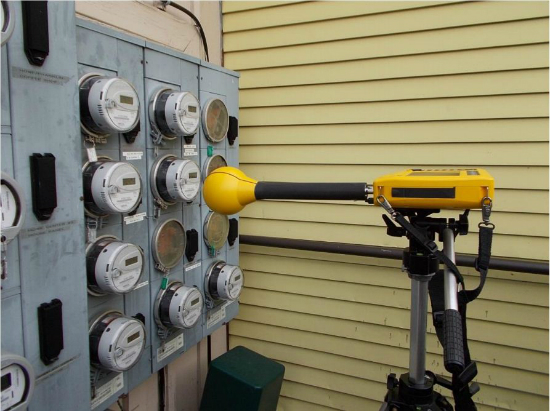
An evaluation by an outside consultant of the radio frequency fields produced by Smart Meters deployed in Vermont by Green Mountain Power and Burlington Electric Department has found that the emissions are well below federal guidelines for safety, and in fact were less than cell phones, microwave ovens and regular FM radio. The report was issued in mid-January and released Wednesday by the Vermont Public Service Department.
The PSD submitted its report, entitled An Evaluation of Radio Frequency Fields Produced by Smart Meters Deployed in Vermont, to the Senate Committee on Finance and the House Committee on Commerce and Economic Development. The report was commissioned by the PSD at the direction of the Vermont Legislature pursuant to Act 170 the Vermont Energy Act of 2012.
The report prepared by Richard Tell Associates is based upon laboratory testing and field measurements of a representative sample of wireless smart meters currently deployed in Vermont in the service territories of GMP and BED. The report concludes: Applying the highest indicated results from the measurements performed in this study, the radiofrequency (RF) fields associated with the currently deployed smart meters in the GMP and BED service territories are small when compared to the limits set by the Federal Communications Commission (FCC). It is concluded that any potential exposure to the investigated smart meters will comply with the FCC exposure rules by a wide margin.
Based on field measurements, the highest instantaneous peak value at one foot from a meter was 3.9 percent of the FCC limit. The peak value at one foot for a cordless phone was measured at almost one percent of the limit, a microwave at 6.5 percent, and a cell phone at 10.5 percent. FM radio broadcast emissions, providing continuous exposure over the entire body, were almost nine times greater than the smart meter RF field at a one foot distance and 400 times the smart meter field at ten feet from a meter.
SUMMARY
During November and December, 2012, a comprehensive series of measurements was performed for the Vermont Department of Public Service to evaluate radio frequency (RF) emissions produced by electric smart meters deployed within the state. A primary impetus for the study is the current public concern about smart meter generated RF fields (the signals produced by the meters) and the potential for such fields to cause adverse biological effects. This study was aimed at assessing compliance of smart meter signal intensities with regulations established by the Federal Communications Commission (FCC) that prescribe limits for safe exposure of humans.
As commonly implemented in many parts of the country, the smart meter systems investigated in Vermont are configured as mesh networks wherein each end point meter installed on a home can wirelessly communicate with other neighboring meters as well as data collection points referred to as Gatekeepers by Green Mountain Power (GMP) and Cell Routers by Burlington Electric Department (BED). Each data collection point can serve some hundreds of end point meters and send the electric energy consumption data received from the meters back to the electric utility company via a wireless wide area network (WWAN) or over a fiber optic network.
The study included extensive measurements of smart meter RF fields in one of the GMP service territories in the Rutland, VT area and in the BED service territory within Burlington, VT. In total, measurements were conducted at 37 different locations in the state which included 18 residential sites, six banks of smart meters (four of which were on residences), two data collection points (one each in the GMP and BED areas), one isolated meter and 14 general environmental measurement sites. Field measurements were accomplished with a spectrum analyzer based selective radiation meter (Narda model SRM-3006) permitting direct measurement of the intensity of RF fields expressed as a percentage of the FCC maximum permissible exposure (MPE) values. The instrumentation also allowed for time analysis of the detected RF fields from which the duty cycle of the RF emissions could be determined.
The meters deployed by both GMP (manufactured by Elster) and BED (manufactured by Itron) operate as RF local area networks (RF LANs) in the configuration of a mesh network and communicate within the FCC designated license free band of 902-928 MHz. The internal radio transceivers operate at low powers of 182 milliwatts (mW) and 304 mW by GMP and BED respectively.
Besides the RF LAN that operates in the 900 MHz region, an additional radio is contained in both the GMP and BED meters that, in the future, can be used to facilitate home area networks (HANs) at customer homes. A HAN, utilizing radios that operate in the 2.4 GHz band, will allow, for example, the customer to observe in real time their residential consumption of electric energy. This feature had not been implemented within the BED service territory at the time of the field measurements but GMP has a pilot project of evaluating customer reactions to a HAN in a sample of residences in the Rutland area. During this study, it was observed that all GMP meters emitted short, infrequent RF pulses from the HAN radios though some 500 meters were commissioned to communicate with in home display (IHD) devices. Hence, field measurements included determining the same characteristics for the HAN radio emissions in Rutland as was performed for the RF LAN emissions.
RF fields were measured as a function of distance in front of smart meters and throughout most of the homes to which the meters were attached. The measurement approach involved detecting the instantaneous peak value of the pulsed RF fields emitted by smart meters to examine how the RF field decreases with distance from the meter. Separately, strategic measurements were made to assess the duty cycle of meter emissions at many locations with a focus on determining the greatest duty cycle that could be achieved. The duty cycle of a smart meter is a measure of how the average value of RF field is related to the peak value of RF field. By knowing the duty cycle, the peak values could be adjusted to arrive at their corresponding time-averaged values.
Field work in Vermont was supplemented with measurements on two test meters provided by GMP and BED in Colville, WA. Many measurements were performed over half-hour periods, both in Vermont and in Colville; 30 minutes is the averaging time specified in the FCC RF exposure regulations.
As a means for forming a perspective on potential smart meter RF exposures, additional measurements of ambient levels of FM radio and television (TV) broadcast signals as well as mobile phone base station signals were made in Rutland, Burlington, Montpelier and Saint Albans, VT. Additionally, as the opportunity presented itself, limited measurements were also made of RF emissions of microwave ovens, wireless routers used for distribution of Internet connectivity and a mobile phone. Azimuth and elevation plane patterns of RF emissions of the smart meters were determined and measurements were made of low frequency electric and magnetic fields from 0 to 100 kHz with the test meters in Colville.
Measurement data collected during the project support the following conclusions in regard to potential exposure associated with the smart meters investigated in Vermont: The instantaneous peak value of RF field, during the pulses, may be as high as 3.9% of the MPE at the closest distance measured of one foot.
Consistent with certification reports filed with the FCC on behalf of smart meter manufacturers by independent test labs, the instantaneous peak values of RF fields found in this study, without any consideration of time or spatial averaging, comply with the MPE.
Smart meters produce intermittent bursts of pulsed RF fields that are small when compared to the FCC MPE for public exposure
When the field is adjusted for duty cycle and spatial averaging, in accord with FCC rules, the resulting maximum value of potential exposure at one foot directly in front of the meter represents about 0.068% of the time-averaged/spatialaveraged exposure limit for GMP meters and 0.032% in the case of BED meters.
The smart meter emissions decrease sharply with increasing distance from the meter being equivalent to about 0.0013% of the exposure limit (time averaged and spatial averaged) at 10 feet from the meter (equivalent to 3,800,000 times less than the actual hazard threshold).
Maximum duty cycles were in the 34% range and were comparable to duty cycles found in earlier studies [1, 2].
Exposure, in terms of instantaneous peak as well as time-averaged RF fields, caused by deployed smart meters in Vermont is small in comparison to that related to many other sources of RF fields in the environment. For instance, local values of long term, time-averaged RF fields (as a fraction of the MPE) from FM radio broadcasting can, in some areas as found in this study, be as much as ten to hundreds of times greater than those values found immediately near smart meters. The common use of normal appliances within a home or office, such as microwave ovens and wireless routers, can lead to RF fields that are comparable to or substantially greater than those produced by smart meters. This applies to the use of mobile phones as well; both mobile phones and smart meters operate with roughly the same transmitter peak powers. In this context, however, mobile phones are normally held against the head during use while smart meters are not.
Low frequency electric and magnetic fields produced by the smart meters and their internal switch mode power supplies, at one foot from the meters, were substantially smaller in value than recommended limits [13].
Smart meters make use of pulsed RF signals, a characteristic common to other devices found in the everyday environment such as wireless routers, radar systems used for air traffic control and most mobile phones.
Peak RF fields associated with large banks of smart meters are not materially different from those of a single meter. Average RF field levels can be greater due to the number of meters. However, there is no general correlation between overall higher average RF fields associated with large banks of meters since the greatest duty cycle of any given smart meter appears to be more related to a specific meters position within the wireless networks hierarchy, i.e., how close it is, from a communications perspective, to its data collection point. Hence, a single meter that serves to relay energy consumption data from many other meters to the data collection point can exhibit a greater time-averaged RF field than a large group of meters that are not close, network wise, to a data collection point.
Of 141 interior RF field measurements inside residences, the greatest measured value was equivalent to 0.0014% of the MPE in term of timeaveraged and spatially-averaged exposure. This maximum value was associated with a location directly behind the installed smart meter but inside the home. The average interior residential RF field, time and spatially averaged, was equivalent to 0.000058% of the MPE.
The FCC MPE values were derived with the inclusion of a safety factor of 50 below the actual threshold of hazard from prolonged exposure. When the above estimated RF field exposures for GMP and BED meters at the closest distance of one foot are considered in this light, this means that the most conservative estimates of potential exposure range between approximately 75,000 and 156,000 times less than the hazard threshold respectively. Using the highest indicated results from the measurements performed in this study, potential exposure of individuals to the RF fields associated with the currently deployed smart meters in the GMP and BED service territories is small when compared to the limits set by the FCC. It is concluded that any potential exposure to the investigated smart meters will comply with the FCC exposure rules by a wide margin.
(1)For convenience in this report, the term pulse is used interchangeably with the term burst.
January 14, 2013 Prepared for The Vermont Department of Public Service By Richard A. Tell and Christopher A. Tell, Richard Tell Associates, Inc., 1872 E. Hawthorne Avenue Colville, WA 99114
A copy of the report: An Evaluation of Radio Frequency Fields Produced by Smart Meters Deployed in Vermont is available at: http://publicservice.vermont.gov