

by Anne Galloway vtdigger.org Northwestern Vermont has among the highest gas prices in the nation and state officials say a few powerful gas distributors have no incentive to lower per gallon prices for consumers.
Gas prices are consistently 10 cents to 20 cents higher in Chittenden and Franklin counties than in other areas of the state, and Vermonts prices more generally are higher than neighboring states, according to research from the office of US Senator Bernie Sanders, I-VT.
On average, gas retailers are making 33 cent per gallon profits in Chittenden and Franklin counties, Sanders told Vermont lawmakers at a hearing on Tuesday.
Sanders conclusion? A few companies two in Franklin County and four in Chittenden County control the market and there is not enough competition to drive down the price.
In my view this is a situation in which a handful of distributors are controlling the market to a very significant degree, Sanders said. The question is, are they doing something illegal? Hard to determine. Do I believe they get on the phone every morning and act in a collusive way and ask how much are you going to charge tomorrow? I doubt that very much, but we have heard they almost acknowledge that the way they do pricing is to look out window and see what the other guy is charging. When you do not have vigorous competition like they have in Middlebury and Springfield and towns along the New Hampshire border, there is no incentive to lower the price.
The senator urged Vermont lawmakers to take a hard look at this issue.
People are getting ripped off, including many working families who just cant afford to pay 10 cents, 15 cents, 20 cents a gallon more than they should pay, Sanders said. The answer is simple: Those owners who control the market have no incentive to go forward with vigorous price competition.
Lawmakers heard testimony Tuesday from representatives from Oil Price Information Service and gasbuddy.com, both of whom verified Sanders assertions.
Source: www.vermontgasprices.com. Jan 24, 2013
Fred Rozell, the retail pricing director of OPIS, told legislators that the Burlington market is the 15th highest in the nation. Even though Vermont combined local, state and federal taxes on gas are 6.3 cents lower than Massachusetts taxes, prices in Vermont have been consistently higher than the prices paid in Massachusetts. There were only two occasions over a 24 month period from January 2011 and December 2012 in which the average price in Vermont was less than the average price in Massachusetts, Rozell said.
In June 2012, for example, Vermonters paid $3.66 a gallon on average, while Massachusetts residents paid $3.49 on average. Its quite puzzling to say the least, Rozell said.
Gas prices reflect cost of doing business in Vermont
Industry representatives, including Skip Vallee, CEO and chairman of RL Vallee, a company founded by his grandfather, attributed the higher prices at the pump to the high cost of doing business in Vermont.
Vallees company runs 28 convenience stores in Vermont and seven in New York and one in New Hampshire, most of which are operated under the Maplefields brand. He employs 480 Vermonters and delivers fuel to 21 independent customers in Vermont.
Customers pay a higher price at his convenience stores for a higher quality experience, Vallee said. His company offers a safe, attractive shopping experience for customers and perks like spotless bathrooms adorned with fresh flowers.
His company, he said, couldnt be more transparent about gas prices after all, he said the per gallon rate is advertised on a 5-foot by 12-foot sign.
He blamed higher prices at his station on a variety of factors that boiled down to this: Its no secret that the cost of living in Vermont is high. Income taxes, property taxes, and even sales and gas taxes are a real challenge and should be a top priority for our elected officials, Vallee said. He pays double in property taxes for a station in Vermont (about $56,000 a year) as he does for a store in New York (about $22,000).
Not to mention the cost of crude. Vallee argues that Vermonts higher prices at the pump come down to wholesale distribution of oil. He recommended that the state obtain crude from the Portland pipeline. The price of Northeast product could decline by 36 cents a gallon if we had pipeline access to oil sands and Midwestern crude, Vallee said.
Vermont Attorney General Bill Sorrell. Photo by Roger Crowley
Of course, many will say that Canadian oil sands are an inappropriate source, citing global warming concerns, Vallee said. To those folks, I would reiterate my earlier statement about having to base decisions on facts and the fact is: The cost to Vermonters for that principled position is 36 cents a gallon not to mention the increased instability of buying from unfriendly nations.
Vallee took Sanders to task for extolling the lower price promises of the out-of-state, big box, multinational corporation, Costco Wholesale and for encouraging Costco to build a filling station even though it has been in violation of its Act 250 permit. The Chittenden County district environmental commission is expected to make a decision about whether to approve the gas station in the next few days.
Joe Choquette, a Downs Rachlin Martin lobbyist for the American Petroleum Institute, said the numbers reported by gasbuddy.com and OPIS dont include transportation costs, credit card fees, the difference in wholesale prices in Burlington compared with the average nationwide. It costs a nickel per gallon to transport gas 75 miles, and credit card fees eat up another 10 cents a gallon. As of Jan. 15, the average per gallon gross margin, he said, is about 13.71 cents. Sales volumes in Vermont are the second lowest in the nation (after Alaska), he said, and that has an impact on profits.
Fostering competition through regulation
Lawmakers mulled what, if anything, can be done about the disparity in pricing between Northwestern Vermont and the rest of the state and Vermont and other states in the region.
Vermont Attorney General Bill Sorrell suggested four steps the Legislature can take to foster competition.
He recommended that Vermont lawmakers follow Maines lead and require his office to report all sales by station owner on an annual basis so we can see the volume of sales and by which owners. Sorrell said that information could be very helpful to his office.
In addition, Sorrell said Maine requires state advanced notice review of mergers of retail and/or wholesale gas companies. His office then could take a quick look at whether a merger could enhance consolidation thereby arguably reduce competition. If not, the attorney general could seek to block such a merger going forward if the facts warrant it.
The state could also require the divorcement or breakup of distributors and retail owners. Right now wholesale distributors often own filling stations. To foster more competition, the state could impose a statute that would force the divorcement of retail station owned by wholesalers at certain levels of consolidation. This would be a more controversial option, Sorrell said, that other states have tried. Some economists have questioned, however, whether divorcement results in increases in pump prices.
We have a situation that is not good for consumers, Sorrell said. We have no evidence right now of outright violations of antitrust laws, but we look for competition, and we hope that through this session you might consider actions that would foster competition for fuel oil in the marketplace.
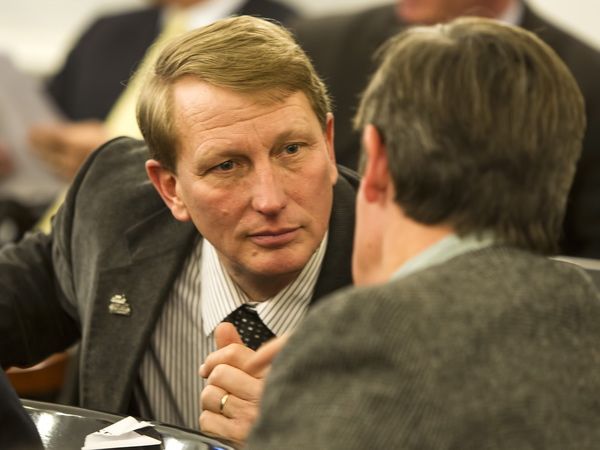
January 23, 2013 vtdigger.org Top Photo: Representative Mark Higley, R-Lowell, talks with Representative Chip Conquest, D-Groton, at a hearing on gas prices at the Statehouse Tuesday afternoon. Photo by Roger Crowley vtdigger.org