

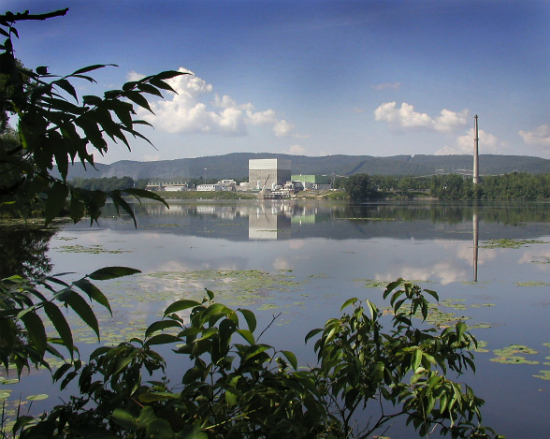
by Timothy McQuiston Vermont Business Magazine The Vermont Yankee nuclear power plant in Vernon will refuel on schedule this spring. Vermont Yankee spokesman Rob Williams told Vermont Business Magazine Wednesday that the Vernon plant will be shut down for the 30th time to be re-fueled since it went online in 1972.
Williams said he could not say, for competitive reasons, when exactly the outage would commence or exactly how long the process would take. But he said the process would entail several weeks’ work from the initial ‘ coast-down’ to back to full power. He said one-third of the fuel rods will be replaced (120 of the 368).
Nor could Williams say what the refueling would cost. During the last refueling outage in October 2011, VBM and other media reported that the fuel cost $60 million and the whole process cost about $100 million.
UBS, the global financial services firm based in Switzerland, had suggested in early February that Vermont Yankee owner Entergy might shut the plant down this year, because it isn’ t generating enough cash. In short, it might be cheaper for Entergy to close it rather than keep it open. For the next 18 months, however, Vermont Yankee will continue to operate.
‘ It’ s a great economic boost to the area,’ Williams said. Along with the 1,100 contractors brought in to replace the fuel and go through a litany of maintenance procedures, some 60 tradesmen from other plants (pipefitters, painters, etc) will be brought to the Vernon site in addition to Vermont Yankee’ s 600 employees.
Altogether, he said, the refueling outage will generate about $2.5 million in local economic activity. He said, of course, that safety is the most important aspect of the job. ‘ It’ s very carefully planned.’
Among the operations planned for the outage to keep the plant up-to-date are: replacing and refurbishing some components; general preventative maintenance; replacing a large transformer; overhauling one of the three feed-water pumps; and replacing a recirculation-pump motor.
Entergy is embroiled in several different fights with the state of Vermont, including in federal court where Entergy has won the first round over whether the state has the right to shut down Yankee. An appeals court hearing on the case was held in January (Second Circuit Court of Appeals January 14). The Vermont Legislature last spring also introduced a new generation tax on Yankee.
More immediate, at least it would seem, Entergy must get approval from local regulators. Yankee needs a Certificate of Public Good, essentially a permit from the Vermont Public Service Board, to keep operating, at least in theory. For now, the federal court has sided with Yankee’ s continued operation because jurisdiction ultimately lies with the Nuclear Regulatory Commission, which granted Entergy a license in 2012 to keep operating Vermont Yankee for another 20 years. Yankee went on-line in 1972.
The plant has been without a current CPG since the previous license expired in March 2012. Entergy, anticipating a legal win, or at least a protracted legal battle, went ahead and refueled the plant in October 2011. The 18-month refueling cycle will conclude this March.
Williams said the next re-fueling would be in the fall of 2014.
UBS had suggested the Vermont Yankee nuclear plant and other older plants in the Entergy fleet, such as New York Fitzpatrick and Indian Point, 40 miles up the Hudson River from New York City, could become burdens to Entergy in the next few years. Already, Entergy has taken a charge on earnings against the uncertainty of Vermont Yankee’ s future. UBS suggests that shareholders may not be happy with a continued drain on the value of their company.
On February 14, UBS Securities downgraded Entergy Corp’ s stock from ‘ neutral’ to ‘ sell.’ Following that report, its stock price, which had been down the last six months, fell a few points lower to its 52-week low of $61.09 (the high of $74.50 was reached last summer).
In its fiscal 2012 annual report, Entergy stated: ‘ An asset impairment ($1.26 per share) of the Vermont Yankee nuclear power plant recorded in the first quarter of the current year contributed to the as-reported decrease.’ Entergy finished the year with earnings of $4.76 per share versus $7.55 per share in 2011.
Julien Dumoulin-Smith of UBS Securities LLC said January 4 in a report that, "We believe both its New York Fitzpatrick and Vermont Yankee plants are at risk of retirement given their small size." He questioned whether operating such plants at a loss made sense. UBS has said that Vermont Yankee is the most ‘ tenuously positioned plant.’
Dumoulin-Smith told Vermont Business Magazine that he wouldn't speculate on why Entergy decided to refuel Yankee, but said, ‘ It’ s clear that management has committed to operate the plant at a cash negative.’
Vermont Yankee is the smallest unit in the Entergy fleet, with a 605 megawatt output. Nuclear electric generation is losing ground to cheap natural gas-fired plants, which also come with fewer regulatory requirements.
In 2011 Entergy bought a gas plant in Rhode Island that is nearly the size of Vermont Yankee (Rhode Island State Energy Center (RISEC), a 550-megawatt power plant located in Johnston, Rhode Island, for approximately $346 million), which does not require an 18-month refueling outage.
Entergy requested last year that ISO New England relieve Vermont Yankee of its capacity supply obligations for 2012-2013, if it were forced offline by the state of Vermont. It received approval from ISO last September.
At the fourth quarter earnings conference call, Dumoulin-Smith and Bill Mohl, President, Entergy Wholesale Commodities, had this exchange on that issue:
‘ Julien Dumoulin-Smith (UBS): ‘¦And then just turning to the EWC segment for a quick second, obviously the New England results came out the other day. Can you indicate whether you committed Vermont Yankee into that auction and whether it cleared by chance?’
‘ This is Bill. We did actually commit VY. And it did clear.
"And you may ask the question why did we do that as we haven’ t in the past but now that that unit’ s been delisted it’ s not considered a reliability must run unit. It takes away a lot of our relicensing risk as it relates to the CPG issue so that in the event that we would encounter any problems we could replace it with a fungible product.’
Rob Williams decline to elaborate on what ‘ fungible’ might mean.
But clearly Entergy is considering all eventualities. At the earnings call on (CLICK HERE) February 8, 2013, Leo P Denault, the new Entergy Chairman and CEO, said:
‘ Near-term power prices are challenging for some merchant nuclear generating units in certain competitive markets. We have not made any decisions to shut down any of our merchant nuclear plants. We are continually assessing our businesses and investments based on our analytical dynamic point of view approach. Our business plans must be flexible to adapt to high and low price markets and must balance short and long-term views.
‘ The fact is some plants are in more challenging economic situation for a variety of factors, such as the market for both, energy and capacity, their size, their contracted positions and investment required to maintain the safety and integrity of the plants. It will come as no surprise to you that some of our EWC nuclear plants are challenged. While we will not get into these specifics around individual EWC plant economics, I will say that there are years when certain plant's cash flows can be negative at today's forward price curve.
‘ In the near-term, we will continue to be diligent and operate as efficiently as possible. We will do whatever it takes to maintain the safety and integrity of the plants. We will also advocate for efficient markets and recognition of the many benefits nuclear plants offer to our communities and our customers, including a source of clean energy with effectively zero air emissions, grid reliability supported by low forced outage rates that fuel diversity, jobs and other contributions to the regional economy.
‘ In addition to economics, EWC efforts continued towards securing necessary approvals for long-term operation of Vermont Yankee and Indian Point. Regarding Vermont Yankee, oral argument at the Second Circuit Court of Appeals was held on January 14th, before a three judge panel. As a reminder this case involves the state of Vermont's appeal that the January 2012 Federal District Court ruling invalidating certain state laws regarding continued operation and borrowing the state from requiring a below market PPA as a condition for continued operation. A decision could come by mid-year. Two days later we participated in hearing at the Vermont Supreme Court. The state court hearing concerned a claim by an intervener group that Vermont Yankee was operating in violation of past Vermont Public Service Board orders. Next steps will be established by the state court.
‘ However, given the Federal District Court rulings and the absence of any state ruling prohibiting operation, we will continue to operate until final decisions are reached in the federal case and in the certificate of public good proceeding before the VPSB.
‘ Our right to continue operating is supported by representations to the Federal District Court by the Vermont Attorney General. Also at the state level, hearings on direct testimony in the CPG proceeding will be held next week. Additional testimony hearings and briefings are scheduled through August of this year. A Board decision is expected by year-end.’
Vermont Yankee is one of Entergy’ s merchant nuclear plants, which sells wholesale power on the open market.
It appears that until October 2014, at least, the Vermont Yankee nuclear power plant will keep running.
At whatever point the plant does shut down, the method of that closing will generate a whole new set of issues.
In particular, the NRC allows for a nuclear plant to be mothballed before it is decommissioned in a process it calls SAFSTOR. SAFSTOR would allow Entergy to secure the site but not remove the radioactive material and remediate the site for up to 60 years. This is much cheaper for the company, as it allows the radioactive materials to deteriorate somewhat, which lowers handling costs, while allowing the decommissioning fund to grow.
2.20.2013. Timothy McQuiston is editor of Vermont Business Magazine.
RELATED STORIES:
In UBS report, financial firm forecasts that Entergy may close ...
Feb 6, 2013 ... In an investment research letter, the Swiss financial services company UBS Securities anticipates Entergy Corp will retire one of its nuclear...
www.vermontbiz.com/.../ubs-report-financial-firm-forecasts-entergy-may- close-vermont-yankee
Vermont Yankee owner Entergy reports fourth quarter, annual ...
Feb 8, 2013 ... In part due to an "asset impairment" related to the VermontYankee nuclear power plant in Vernon, Vermont, Entergy Corporation's (NYSE: ...
www.vermontbiz.com/.../vermont-yankee-owner-entergy-reports-fourth- quarter-annual-earnings
$12.5 million generating tax on Vermont Yankeeapproved by ...
Apr 26, 2012 ... by Alan Panebaker vtdigger.org On Wednesday, the Senate Committee on Finance approved a miscellaneous tax bill that includes a proposal ...
www.vermontbiz.com/.../125-million-generating-tax-vermont-yankee- approved-senate-finance-committee
Cheryl Hanna: Recap of the Entergy/Vermont Yankee oral ...
Jan 15, 2013 ... by Cheryl Hanna, Professor of Law, Vermont Law School It isn't often that you get to watch two of the best constitutional lawyers in the country ...