

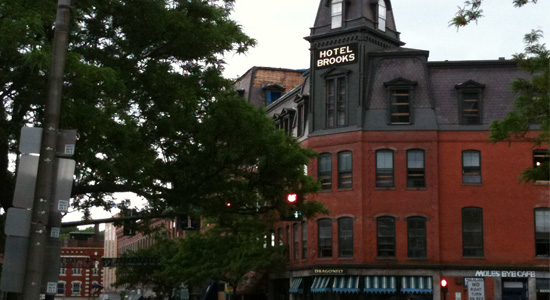
by Timothy McQuiston Vermont Business Magazine The final piece of the re-development of the Brooks House in Brattleboro came together at the end of January with a financing commitment from two local banks. The Brooks House was gutted by fire in 2010 with the loss of apartments, retail and restaurants. But perhaps the most deleterious result of the fire was the blighting of the signature building at the town’ s busiest corner.
According to Downs Rachlin Martin attorney Craig Miskovich, getting the funding together took longer than an expected because of the complicated nature of project.
The $20 million Brooks House redevelopment, like a few other notable projects, is being funded in part by New Markets Tax Credits (see detailed explanation below). These tax credits, while being around for more than 10 years, are only just starting to gain traction. The reason for this is because they appear to be expensive and complicated, two things developers and banks tend to shy away from.
Miskovich said the lead lenders for the Brooks deal will be a collaboration between Brattleboro Savings & Loan and Mascoma Savings Bank. While it is typical to have only one lead lender, Miskovich said they were able to put a project together to keep the financing local.
The complicated nature of the New Markets projects, and their relative newness, makes the experience of financial institutions rather limited. Mascoma has experience in this type of financing.
The New Markets Tax Credits were recently re-authorized by Congress in the "Fiscal Cliff" settlement at the end of 2012. The tax credits allow investors ‘ an individual but more likely a financial institution ‘ to reap a 39 percent tax credit spread over seven years.
This is a great deal for investors. While they may get a very small return on their investment (1 percent or less) the tax credit on the flier’ s federal income tax return is the windfall. It's also a windfall for the developer.
Miskovich's colleague at DRM, Dale Rocheleau said, "(New Markets Tax Credits ) make a project that was otherwise not viable into a viable project."
The whole thing is nearly impossible to explain, which explains the expense.
Basically, there is a project that needs done that otherwise would have a difficult time getting funding; there are individuals and corporations out there looking for a tax break who have money to invest and their investment lowers the overall capital cost of the project; there is a local entity looking for suitable projects with tangible social benefits to support and which is able to allocate the federally designated tax credits; and there are banks always looking for good projects to finance.
If this sounds complicated, it is.
Roger Prescott, of DRM's Burlington office, explains that the legal and tax advice his firm, or any other, would provide will cost the developer a lot of money. He says that under normal conditions no developer would want to bite off that much in overhead for the types of projects involved. But the cost of the financing from the NMTC investors is so low and the money that becomes available is so large compared to the project size, that the deals become very attractive and the resultant funds more than cover the expense.
The so-called new markets are low-income areas as determined by the US Census Bureau. Congress sees it as a way to bring investment to underserved areas. It comes as no surprise that most of Vermont qualifies. Even most of downtown Burlington is covered.
The nearly "free money" aspect of the NMTC has been seen as similar to the EB-5 investment strategy, which is funding most of the $600 million development at Jay Peak, Newport and other areas of the Northeast Kingdom.
With EB-5, the investors are foreigners looking to gain a Green Card to the United States by making a sizable investment (at least $500,000 and in some regions $1 million) in a project. Like EB-5, the NMTC investor does not have to be involved in the development. As long as the development is successful, their money is their only commitment.
But NMTC projects are more complicated. A local organization, called a Community Development Entity (administered in Vermont by Vermont Rural Ventures, which is part of Housing Vermont) receives an allocation of tax credits from the US Treasury and selects projects to invest in.
The bottom line is that despite the complicated nature of these deals, the NMTC lowers the cost of capital and therefore lowers overall project costs.
Some of these deals are big deals indeed, including commercial and industrial projects.
Just down Route 9 from the Brooks House is the Commonwealth Dairy plant. Commonwealth originated in Massachusetts, hence the name, but located in Brattleboro. Originally it started out making traditional yogurt, but when Greek yogurt exploded in popularity in 2011, the plant began making that style of rich, dry, and expensive, yogurt.
‘ Our production and expansion in Brattleboro has far exceeded our most optimistic projections when we launched this project in 2010,’ said Commonwealth Dairy’ s President and CEO Tom Moffitt at the time of the announcement last November. ‘ In less than two years, we have become a leading producer of authentic strained Greek yogurt, including our own Green Mountain Creamery brand."
While Commonwealth does have its own label, it mostly packages its yogurt for private label retailers, such as Costco's house brand.
DRM's Miskovich, Rocheleau and Prescott.
DRM was involved in the original $28 million NMTC deal in 2010 (which did not involve VRV) and the more recent $12.5 million expansion (with VRV). With the expansion, Commonwealth was able to add 34 new jobs to its workforce of 110.
DRM, with offices in several locations across the state, has been involved in five projects total, ranging in size from a $3 million deal with Laraway Youth and Family Services in Johnson, to the $40 million expansion of the EHV Weidmann manufacturing plant in St Johnsbury.
The Weidmann deal was not only a major NMTC project, it also involved tax credits from the state as well as financing through the Vermont Economic Development Authority. The investment in the high-voltage insulation manufacturer solidified Weidmann's position as the most significant such company in North America and one of the Northeast Kingdom's most important employers. The deal helped sustain the 315-person workforce.
‘ Yes, indeed, it preserved jobs,’ Vice President John Goodrich said.
Goodrich said the investment the Swiss owner put into the plant could have gone anywhere in the world and would have if not for the tax credits.
‘ The simple fact for us is that we have many more (financially) attractive places in the world to do business,’ Goodrich said. ‘ The tax credit made it possible to compete.’
‘ I’ m very grateful to all those who participated,’ he said.
Goodrich did acknowledge the use of NMTC was ‘ complex and daunting.’ He said his CFO who signed the documents ran out of ink in his first pen.
‘ It’ s a rather complicated deal structure to put together,’ said DRM’ s Dale Rocheleau, with some measure of understatement.
Not only are the deals complex, said DRM’ s Roger Prescott, getting the allocation of these limited tax credits is a competitive process for the CDEs, based on things like the rural nature of the area, whether it is underserved, the previous success of the CDE and the number of jobs created.
‘ It’ s a very competitive process. There’ s a limited number of dollars available,’ he said.
Vermont Rural Ventures has submitted an application for a new allocation of $80 million.
‘ We’ re all very hopeful that they’ ll get a large portion of that,’ Prescott said.
Nancy Owens, President of Housing Vermont and Vermont Rural Ventures, said that in the previous allocation round, VRV applied to the Department of Treasury (under the CDFI) for $65 million and got $35 million.
‘ We want to invest in projects that have real value to the community,’ she said.
The NMTC investors, which Owens said are mostly banks, are also looking for such projects and must do their own due diligence on each project in which they invest. Failures are rare, she said, but they do happen.
Even in a qualified census track, not every type of project will qualify. For instance, Owens said, golf courses, liquor stores and strictly residential do not qualify. A project cannot be more than 80 percent residential. But otherwise, projects as diverse as the Laraway School, Weidmann and the Brooks House can qualify.
‘ That’ s one of the great things about this is that you can use it for so many different types of projects,’ Owens said.
Craig Miskovich said, ‘ As the program has aged and we’ ve had the 2010 census track, those eligible tracks were re-drawn and significantly more communities in Vermont now qualify. Under the 2000 census track, no part of Springfield, Vermont, qualified, no part of Bellows Falls qualified.’
In part, Miskovich said, the number of eligible communities expanded between the 2000 and 2010 censuses because there has been a growing income disparity between Chittenden County and the rest of Vermont.
Brooks House
In the case of the Brooks House, it was an 85,000-square-foot, mixed use, historic building. On April 17, 2011, a fire gutted the top floors and forced the rest of the building to close. In all, there were 60 ‘ down-market’ apartments, some office space and strong retail on the ground floor.
The town wanted to bring it back as mixed use, with an upgrade to the residential apartments, more office space and refurbish the retail space. The redevelopment cost was estimated at $20 million.
Building owner John Chase quickly determined he couldn’ t do the whole project himself. So Bob Stevens, the architect, working with Miskovich, put together a group of local investors who would raise the capital. Practically the first call they made was to Vermont Rural Ventures (a subsidiary of Housing Vermont). Developers are not limited to the local CDE and other developments, including Weidmann and Commonwealth, have used CDEs outside the state. For its part, Vermont Rural Ventures only does Vermont projects.
But in doing a New Markets deal, the first step is to find a CDE with tax credit allocation, so they called VRV.
‘ We were fortunate enough for the Brattleboro project to be put in their high priority track because of the importance of that building to downtown,’ Miskovich said.
‘ You won’ t have a New Markets deal without that allocation. But they’ re leveraged transactions. That’ s what makes the transaction interesting for a tax credit investor, and that leverage typically comes from a traditional commercial lender here in Vermont.’
Some of the provisions for the lender are ‘ atypical,’ meaning that there is some education required, so finding a lender with NMTC experience makes the process easier, which is where Mascoma and Brattleboro Savings come in.
‘ The tax credits were essential to rehabilitating that building,’ Miskovich said.
Miskovich said the closing is expected in April, with construction to follow immediately after that, with occupancy by April 2014.
New Markets Tax Credit Program
Congress created the New Markets Tax Credit (NMTC) program in 2000 to spur investment of private capital for economic development in both rural and urban low-income communities. Individuals and corporations receive a tax credit against federal income taxes for making investments in certain low-income properties or businesses when those investments are made through a ‘ community development entity’ (CDE).
Vermont Rural Ventures (VRV www.hvt.org/vermont-rural-ventures/), a qualified CDE operated by Housing Vermont, secured its first allocation of NMTC in the spring of 2009. Vermont Rural Ventures is deploying its New Markets Tax Credit resources to support investment in the economic, environmental, and social well-being of Vermont communities. NMTC funds are used to retain and create jobs for Vermonters by financing key community developments in downtown and village centers and in other concerted community efforts which demonstrate positive impacts on Vermont’ s economic, health care, energy and food systems.
Upon making an investment in a CDE, the NMTC provides a 39 percent federal income tax credit over seven years. Investors receive a tax credit equal to 5 percent for each of the first three years and 6 percent for each of the last four years. Investors can be any taxable entity, individual, corporation or investment fund. Typically investors are banks, insurance companies, venture capital and other investment funds, corporations and individuals.
Prospective NMTC projects generally need to be located in qualified census tracts. In Vermont those areas include much of northern Franklin, Lamoille, Essex and Orleans counties as well as parts of the towns and cities of St. Albans, Rutland, Bennington, Fair Haven, Burlington, Winooski, Newport, St Johnsbury and Brattleboro.
VRV evaluates NMTC investments for retail and office space, health care projects, downtown housing over commercial space, manufacturing, community centers, farm, forest, and food processing, and energy projects and will invest in both new construction and historic renovation. VRV is targeting 70 percent of its NMTC funds to rural areas of Vermont.
CASES
Weidmann Electrical Technology, Inc
Vermont Rural Ventures partnered with National Development Council and Massachusetts Housing Investment Corporation, who together provided $34.55 million in NMTC authority to construct a building addition and purchase and install an 800-ton hot press machine for lease to WEIDMANN Electrical Technology, Inc (WETI).
WETI is a wholly-owned subsidiary of WICOR, part of a privately-held multi-national corporation owned by WICOR Holding AG, based in Switzerland. WETI is the market leader for a broad spectrum of cellulose-based insulation primarily for high-voltage electrical transformers, but also for other applications where insulation from high temperature is required. WETI operates a specialty paper mill in St Johnsbury that is the only producer of transformer board insulation in North America; it supplies this insulation and associated fabricated components primarily for use in large transformers.
The project consisted of the construction of a 36,790-square-foot addition to WETI’ s existing manufacturing building and the purchase and installation of a new hot press. The building and hot press is leased by the QALICB to WETI. The new hot press is an 800-ton piece of equipment that performs a critical function in the manufacturing process, drying and compressing the board to the specification needed to provide the desired insulating quality. The previous hot press dates to 1955, and needed to be replaced if the plant was to continue operate at its present capacity and maintain employment levels.
This investment secures 260 jobs on the WETI campus in St Johnsbury. These are among the best jobs in the region. The project also created 60 FTE construction jobs. The State of Vermont responded to the potential for losing jobs at the WETI St Johnsbury plant by offering a 10 percent state income tax credit on investment up to $80 million at the site and granting $25 million in Recovery Zone Facility Bond financing through VEDA. The new, larger hot press also offers the potential to increase capacity and therefore jobs in the future if higher demand levels materialize.
A portion of the proceeds from the transaction were used to establish a training program for machine shop operation (a 12 week program ‘ both classroom and hands-on machine time) that local industry had requested, given that a substantial portion of the workforce will reach retirement age in the coming years. The Northern Community Investment Corporation is collaborating with Lyndon State College, White Mountains Community College, WETI, Vermont Aerospace, NSA Industries, and Northeast Precision, among others, to operate the program.
Laraway Youth and Family Services
Housing Vermont, through its Vermont Rural Ventures affiliate, is providing nearly $3.3 million in low cost permanent financing to Laraway Youth and Family Services (LYFS) for its new, 39-acre campus in Johnson. The project allows the nonprofit youth services organization to increase enrollment by 30 percent and to add 10 to 12 new employees.
‘ This is a sound investment on two levels. Not only does it provide a fair rate of return to the Bank, but it also strengthens our community by helping our youth. Laraway Youth Services has an excellent track record working with the youth in our area, and we are very pleased to be a part of this great project’ said Stephen Marsh, CEO of Community National Bank.
Located on Route 15 one mile west of Johnson village, the new LYFS campus includes a fully renovated farm house and a newly constructed 12,550 square foot school providing a total of 16,800 square feet of instructional and office space. LYFS leases some of the land to a neighboring farm and plans to develop agricultural work programs for its students.
Laraway serves youths in grades K to 12, offering individual special education, therapeutic foster care behavioral management, and therapy services. LYFS typically serves 90-100 youths and their families each year. With the new building they have the capacity to enroll additional youths and hire more staff as demand dictates.
Greg Stefanski, Laraway Youth & Family Services’ Executive Director, said that, ‘ Laraway’ s new financing structure, involving New Markets Tax Credits and coordinated by Housing Vermont, is reaping immediate and long-term benefits for Vermont’ s most vulnerable youth and their families. We have significantly reduced our monthly mortgage payment and cut our loan from 25 to 20 years. This means more resources will be available for direct education and treatment services.’
‘ We are grateful to Nancy Owens and her staff at Housing Vermont for their efforts to improve the lives of young people in Vermont today and into the future,’ Stefanski said.
Commonwealth Dairy
Commonwealth Dairy in Brattleboro, which opened in March 2011, announced a $12 million investment in new facilities and equipment for its plant last November. The plant’ s current production output includes more than 100,000 cases of packaged yogurt per week. The expansion project will add 23,000 square feet to the facility, including a new processing line, warehouse space, a new filling machine, fermentation tanks, wastewater treatment improvements, and new whey processing and packaging equipment. Extra office space will be part of the expansion as well. Expected to be completed by April 2013, the project will add as many as 34 jobs to its existing staff of 110.
The Massachusetts Housing Investment Corp has sponsored two investments to Commonwealth Dairy, part of the initial $28 million allocation in 2010 ($18 million) and then the expansion announced in November 2012 ($6 million), with Vermont Rural Ventures sponsoring the rest of the $12.5 million project.
Community College of Vermont
DEW Construction Corporation’ s new 32,000-square-foot building in downtown Rutland, for use by the Community College of Vermont, opened in January 2012.
US Bank has invested $10.1 million in Vermont rural Ventures, which made a qualified low income community investment in an affiliate of DEW which owns the building. The DEW affiliate built and will operate the new commercial facility that is leased to Vermont State Colleges for the Community College of Vermont. The developer will also use Recovery Zone Facility Bonds issued through the Vermont Economic Development Authority and purchased by the Mascoma Savings Bank.
The project revitalized the busy intersection at Wales Street and West Street (Route 4) on one of the main roads leading into the central part of the City of Rutland. The project removed several buildings, some of which were abandoned and in disrepair, and cleaned up a state high-priority brownfield site.
CCV’ s Rutland location, the fastest growing site in the system, had been unable to meet the demand for classes due to the lack of space at its previous facility. Over 1,000 students a week pass through the doors of CCV.
Timothy McQuiston is editor of Vermont Business Magazine.