

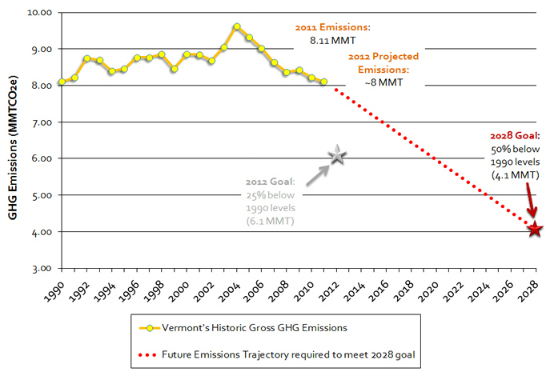
The latest update of Vermont's greenhouse gas emissions (GHG) inventory shows Vermont is making progress, but is still short of achieving its goals. In 2006, the Vermont legislature set a goal of reducing the state's GHG emissions by 25 percent from 1990 levels by 2012; 50 percent by 2028; and, if practical, 75 percent by 2050. In 1990, Vermont emitted just over 8 million metric tons of greenhouse gasses.’
Secretary of the Agency of Natural Resources, Deb Markowitz said "This year's GHG report shows that Vermont's greenhouse gas emissions decreased slightly in 2010, and again in 2011 to an estimated 8.11 million metric tons of carbon dioxide equivalent (MMTCO2e), a level equal to 1990 levels. Emissions from most sectors declined or remained constant between 2010 and 2011."’
"The good news is we are headed in the right direction," Secretary Markowitz said, "Our investments and policies are beginning to work - but we cannot get complacent."’
"We will need to redouble our efforts if we are to achieve the emission reduction goals we have set ourselves," she said.’
Reductions in the transportation sector are primarily attributable to Vermont's adoption of the California vehicle emissions standards, economic drivers such as higher gas prices, and changes in travel behavior. Reductions in heating fuel consumption are being driven by improving building weatherization and efficiency, higher fuel prices, and warmer winters.’
Total electricity consumption in 2011 is comparable to 2009 and 2010; however emissions from this sector have risen slightly because of a greater reliance on higher GHG-emitting regional market power in Vermont's electricity contract mix.’
Markowitz said, "Unlike many of our sister states, whose top contribution to GHG comes from electricity, the majority of Vermont's carbon pollution comes from the transportation sector, with the second highest contribution coming from fuel oil used for home and commercial heating. To bend the curve on Vermont emissions we must to continue to make our homes, businesses and public buildings energy efficient; we need to continue to make investments in new renewable energy; we need to support our traditional land use patterns with walkable, livable village centers surrounded by a working landscape and forested mountains; and we must continue to put the infrastructure in place to make it easier for Vermonters to choose to drive zero emission vehicles.’
The full GHG inventory report is available at http://www.anr.state.vt.us/anr/climatechange/Vermont_Emissions.html
‘
‘