

by Anne Galloway vtdigger.org A boost from the Federal Emergency Management Agency and an uptick in state revenues could ease pressure on the stateâ s budget, officials say.
Last week officials announced that Vermont will receive roughly $30 million in additional public assistance for the Irene recovery effort.
Roads and infrastructure in 200 towns sustained hundreds of millions of dollars in damage when Tropical Storm Irene scoured central and southern Vermont on Aug. 28. The storm ruined 500 miles of roadway, totaled the Waterbury state office complex, damaged municipal buildings and destroyed hundreds of homes. Forty to 50 towns were severely damaged.
State and local officials have been restoring roads and infrastructure with the expectation that FEMA will reimburse much of the cost. All along, state officials had hoped the federal government would give the state extraordinary relief; the expectation was that Vermont would exceed the $127 per person or $80 million damage threshold and would qualify for the higher Public Assistance match rate.
Vermont is very close to hitting the threshold, which is based on actual damage expenditures. (FEMA has paid the state $64.7 million, so far.) But the additional relief wasnâ t a sure bet until last Thursday.
Sue Minter, the stateâ s Irene Recovery Officer, said Vermontâ s congressional delegation and the governor had to lobby hard for the funding and the fact that it came through is a big deal. â We were eligible, but it wasnâ t sure thing,’Minter said. â These are uncertain times with regard to the (federal) budget. We didnâ t take this for granted for a minute.â
Gov. Peter Shumlin personally beseeched the White House ‘as did Vermontâ s congressional delegation ‘for a higher federal rate of reimbursement.
On Thursday, Shumlin announced that the president had given approval for the request. â This announcement marks a major milestone in our recovery from Tropical Storm Irene,’he said in a statement. â It will mean significant savings for municipal budgets across the state, and for the state budget as well. We are incredibly grateful to President Obama and the Congressional Delegation, and also to FEMA for this welcome news.â
FEMA will boost the reimbursement match rate for Public Assistance from the standard rate of 75 percent federal, 25 percent state and local to 90 percent federal, 10 percent state and local. The state and municipalities then share the match cost 50-50. Public assistance funding can be used to pay for the restoration of local roads, culverts, bridges and infrastructure, such as schools, water systems and municipal buildings.
The 15 percent increase in the match works out to roughly $30 million in additional dollars that will come to Vermont on top of the estimate of more than $160 million the state anticipates. About $26 million is for public assistance; $4 million is for the hazard mitigation buyout program, in which towns can work with landowners to permanently â undevelop’properties that are prone to future flood damage.
For some towns, the 12.5 percent match would have been extraordinarily onerous. The tiny town of Halifax (population 800), for example, sustained $5 million worth of damage to roads. At the higher match rate, the local taxpayers would have been on the hook for $625,000; the townâ s annual budget is about $700,000.
http://vtdigger.org/2011/11/23/on-video-state-treasurer-frees-up-cash-fl...
Lawmakers and the Shumlin administration recognized that the 75 percent federal, 25 percent state and local match rate could put small towns like Halifax and Wilmington in an untenable financial position. They set aside $5 million to cover costs for towns that would see a more than 3-cent increase in local property tax rates as a result of Irene repairs.
Minter said the shift to the 90 percent match rate wonâ t have an impact on towns. â They wonâ t see a difference ‘theyâ re already protected, the state budget will feel the difference,’Minter said.
An excavator clears mud, rocks and debris from a river in Woodstock in the days after Tropical Storm Irene. Photo by Angela Drexel
Steven Jeffrey, the executive director of the Vermont League of Cities and Towns, said municipal officials were grateful for the stateâ s assistance. â The state already guaranteed our percent was not going to be more than 3 cents,’Jeffrey said. â It made budgeting a lot easier for towns knowing what the cap was going to be.â
Now that FEMA has come through with the 90 percent federal, 10 percent state and local match, some of the $5 million set aside by the Legislature for towns that experienced extraordinary damage could be diverted by the Emergency Board to other Irene recovery costs.
Thatâ s good news for the state budget. Jeb Spaulding, secretary of the Agency of the Administration, said the additional aid will make it easier for the state to cover uninsured damages to the Waterbury state office complex and the new Vermont State Hospital facility.
â The additional money from the feds is a reduction on what the state would otherwise have to spend,’Spaulding said. â It means we wonâ t need to ask the Emergency Board to provide more money for the Emergency Relief Assistance Fund. Thatâ s where that money was going to come from.â
The Legislature set aside $16 million in the Budget Adjustment Act to replenish the fund, which had a balance of $600,000, according to budget officials. That pool of money is to be used for the town property tax relief and other Irene-related exigencies.
â Itâ s not like we have $30 million to spend on something else,’Spaulding said. â Weâ re still in a situation where weâ re not exactly sure what parts of the state complex or state hospital FEMA is going to cover.â
Other good news could also help the Irene bottom line. Tax revenues increased slightly for the second month in a row. The state brought in $10.6 million more than expected in April. Up to $15 million in any surplus dollars from fiscal year 2012 are to be set aside for state infrastructure repairs related to Irene.
Towns, though better off because of the 3-cent cap, will still be affected. The Vermont League of Cities and Towns, which offers a self-funded insurance pool for municipalities, the Property and Casualty Intermunicipal Fund, paid out $13 million for town buildings and other infrastructure after Irene. Recently, the league had to find another reinsurance company for PACIF because rates increased by 30 percent to 40 percent and the level of coverage dropped under the firm it had worked with previously, Jeffrey said. Premium rates for municipalities, however, will remain flat.
Meanwhile, municipal officials continue the painstaking work of keeping the paper trail on track to meet federal reporting requirements. Minter estimates towns have submitted 3,000 worksheets, all of which are undergoing careful review by the regional FEMA office. Any project that costs more than $1 million for another level of review and scrutiny. All of the money goes to the state, which in turn reimburses towns.
State officials plan to unveil the latest Irene damage and cost estimates in a report in several weeks.
FEMA has paid $22 million to Vermonters for individual assistance for households and businesses damaged by Irene.
The federal government will give the state about $98 million for state and local highway repairs.
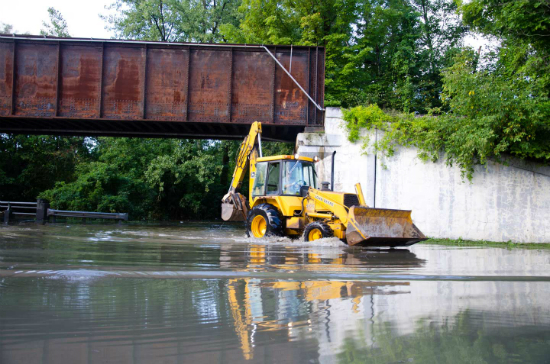
May 21, 2012 vtdigger.orgTop Photo: A backhoe leaves a wake along Irene-flooded Route 2 in Waterbury. VTD file photo/Josh Larkin