

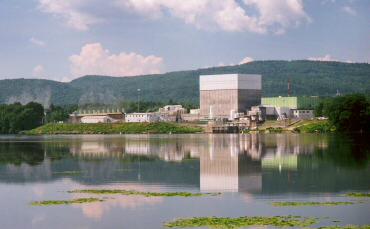
Closing the Vermont Yankee nuclear plant in Vernon on March 21, when its license expires, would have a devastating effect on the Windham County economy, costing hundreds of jobs and the loss of millions of dollars in local tax revenue. It would also cost the state of Vermont millions of dollars in both General Fund and Education tax revenues, according to a report issued yesterday by the Post-VY Task Force.
The Task Force was formed nearly a year ago to attempt to understand the impacts of a near-term or long-term closure of the plant. It found that the impacts would take place on many levels, from tax revenues, to property values, to indirect job impacts, to social implications and that these impacts would be felt even if the plant were allowed to operate another 20 years. The Task Force was charged with trying to find ways to mitigate those impacts as much as possible, regardless of when they might hit, whether that be in one month, 20 years, or at some point in-between.
One of the conclusions of the Task Force was to avoid having plant owner Entergy put the plant into SAFSTOR. This would moth ball the plant for up to 80 years before being dismantled and further damage the local economy on two fronts: One, the site would be unavailable for any other kind of development until the plant is dismantled; and two, dismantling the plant itself would generate jobs and economic activity, which if done immediately, as the Task Force vigorously advocates, would smooth the transition to a post VY economy. One of the Task Force's frustrations is that while the litigation is ongoing between the state and Entergy, negotiations of SAFSTOR have to be suspended.
The Report
The Post-VY Task Force was organized as a subcommittee of the Southeast Vermont Economic Development Planning Group with the directive to study the economic and other impacts that would result from the potential closure of the Vermont Yankee nuclear power station (VY) in Vernon, and ways in which those impacts might be mitigated.
The Task Force first met on March 31, 2011 and has continued regular meetings since then. At the outset, the continued operation of VY past March 21, 2012, the expiration date of its original 40-year operating license, was uncertain, and this uncertainty continues. While a license extension had been issued by the Nuclear Regulatory Commission (NRC) on March 21, 2011, the Vermont legislature had declined to authorize a state-required approval process by the Public Service Board. Then, during the period of the task force’s work, VY’s parent company, Entergy Corporation, sued the State of Vermont in federal court over the conflicts between the state and federal authorization processes. The US District Court judge who heard the suit issued rulings in favor of Entergy and allowing the continued operation of VY after March 21, 2012; the State of Vermont subsequently appealed that decision.
The Task Force monitored these developments and chose to continue its work for several reasons: .
1. Final rulings in the litigation could take several years; and the final outcome could still be in favor of the State of Vermont, potentially requiring the plant to be shut down; .
2. Regardless of the outcome of the lawsuit, Entergy could choose at any time to discontinue operations at VY for economic reasons; and .
3. Even if VY continues to operate until 2032, it will almost certainly be shut at that time, and the area would then face the same economic impacts.
Given the economic presence of the plant and its operations in the region, it is important to understand what the impacts of the eventual closure will be, the implications of different closure scenarios for the acuteness of those impacts, and what can be done to mitigate the impacts throughout the Windham Region.
For these reasons the Task Force and the SeVEDS planning group believe that continued focus on a robust mitigation and growth plan for Windham County is essential.
Process: .
The work of the Task Force covered the following stages: .
§ Listing of all potential impacts from the closure of VY .
§ Research into the impacts and the quantification of impacts where possible .
§ Prioritization of impacts .
§ Listing of potential mitigation steps applicable to each of the major impacts .
§ Prioritization of mitigation steps .
§ Development and discussion of recommended mitigation and growth strategy .
§ Preparation and distribution of this final report .
Task Force membership: .
(Affiliations are listed for identification only) Chair: .
§ Stephan Morse, retired CEO, Windham Foundation Members: .
§ Jeffrey Lewis, executive director, Brattleboro Development Credit Corporation .
§ Barbara Sondag, town manager, Town of Brattleboro .
§ Jesse M. Corum, attorney, Corum Mabie Cook Prodan Angell & Secrest, PLC .
§ Bob Woodworth, owner, Burrow’s Specialized Sports .
§ Andrea Livermore, executive director, Building a Better Brattleboro .
§ Bob Stevens, principal, Stevens & Associates .
§ Art Greenbaum, CEO, GPI Construction .
§ Laura Sibilia, coordinator, Southeast Vermont Economic Planning, BDCC .
§ Chris Campany, executive director, Windham Regional Planning Commission .
§ Connie Snow, executive director, Windham & Windsor Housing Trust .
§ Mark Richards, president, Richards Group .
§ Ellen McCulloch-Lovell, president, Marlboro College .
§ Daniel Yates, CEO, Brattleboro Savings & Loan Association .
§ Martin Langeveld, marketing and media consultant, Vernon Media Services .
§ Robert Oeser, retired employee relations officer, New York State Division of Parole .
§ Chad Simmons, member, Safe & Green campaign .
.
EXECUTIVE SUMMARY .
Impact summary: .
A closure of VY without adequate mitigation steps would have a devastating impact on the region surrounding the plant, with the brunt of the impact felt in Brattleboro, Vernon and the rest of Windham County.
The most serious impacts would be the following: .
1. Job losses: The area will lose between 617 and 650 high-paying jobs at VY itself (estimated 2011 payroll between $68 million and $72 million). More than 400 other area jobs generated by the economic activity of VY and its employees would be lost as well, for a total of more than 1,000 jobs.
2. GDP decline: Major impacts on local retailers, less discretionary spending on local products and services .
3. Major declines in real estate value: Valuation reductions are estimated to be between 5 and 15 percent, depending on the circumstances of the closure.
4. Major declines in available human capital: The loss of many active people who contribute to communities in a variety of ways would have negative impacts on the quality of health care, education, the viability of non-profit organizations, and the capacity to provide work-study and training programs .
5. Major declines in state and local tax revenue: This includes property taxes paid by VY, education fund contributions from VY, property tax reductions due to grand list valuation reductions, sales taxes generated by economic activity resulting from VY and its employees, and income taxes paid by VY employees and contractors, as well as by others whose jobs are jeopardized by a VY closure.
Mitigation plan summary .
The Windham County Post VY committee proposes an Economic Mitigation and Growth program to invigorate economic activity, improve the workforce and preserve the value of commercial and residential real estate inventory. The program proposes the designation of a Special Economic Development Zone, supported by special access to VEDA and CDBG, as well as reduced hurdles to VEGI. The investments can be funded by re-directing a portion of unexpected tax revenues from VY’s continued operation to support these initiatives for at least five years.
The committee takes note of the fact that at whatever point the plant ultimately closes, its owner will have a major choice available to it: whether the plant is immediately decommissioned, or is put into a long-term SAFSTOR. The committee wishes to go on record as supporting immediate dismantlement (DECON) as opposed to SAFSTOR. The latter would delay reuse of the plant site for up to 80 years and withhold the benefits of work crews doing decommissioning work soon after closure. Unfortunately, because of ongoing litigation, there is the unusual situation that negotiations with the plant owner about decommissioning or post-closure economic mitigation can not take place. (This is in contrast to other nuclear plant closings that this sub-committee has studied where there has generally been cooperation in planning between owners and local economic development entities.) .
REPORT DETAIL .
WINDHAM COUNTY POST-VY ECONOMIC MITIGATION AND GROWTH .
Mitigation and growth plan: .
The primary goal of our mitigation plan is, in fact, growth’creating good new jobs and improving wage levels of existing jobs in Windham County. We refer to the developing strategy of the Southeastern Vermont Economic Development Strategy group (SeVEDS) as the core set of goals and strategies to accomplish that. However, the uncertainty of VY’s continued existence and the certainty of its eventual closure raises the urgency of action. We are not just coping with the long slow decline that has marked SE Vermont for fifteen years, but with the prospect of a precipitous change in employment and economic activity whenever the plant owner decides to close. This is likely to occur with very short notice so planning and mitigation needs to begin now.
The average wage is Southeastern Vermont is lower than the overall Vermont, Northern New England, and US averages. Given the high wages and salaries at VY, the plant’s departure will actually reduce the average wage in Windham County making achievement of the goal much harder.
The SeVEDS strategy highlights the need to improve the quality and quantity of the workforce. That will be made far more important when the VY workforce, very highly trained and educated, exits the market. Therefore, a broad focus on workforce is critical to economic growth in Windham County. This includes the proposed CCV/VTC campus, increased integration of the Windham Regional Career Center in training, and effective apprenticeships and internships to introduce young people to businesses and vice versa.
Special Economic Development Zone .
To support this, we urge that Windham County, in recognition of the unique situation caused by the VY conditions, be designated as a Special Economic Development Zone by the State of Vermont.
This designation should bring with it a number of funded benefits including: .
§ Designated funds for marketing ‘ both to aid the tourism segment of the economy, and to raise the profile of Windham County as a good place to work.
§ Enhanced access to capital through VEDA and CDBG, plus the creation of a property redevelopment function, with access to very patient public capital1, to make productive properties that have fallen to lower value uses or out of use. The current ‘downtown’ sites are excellent but require interested and motivated owners. Some properties either do not have such owners or simply don’t have the demand to justify the investment. This is a central part of re-invigorating the Windham County economy’making it a good place to locate a business.
§ Increased investment in social resources to what will undoubtedly be a higher demand driving into a reduced resource pool. VY has been a generous supporter, with money and volunteers, of many of the service organizations of the region. As noted in the detailed impact findings in this report, the area will experience an increase in social needs as total wages go down and property values are impacted.
Creative ways to finance these investments in a Special Economic Development Zone need to be found. The challenge is dramatic’the closure of VY will cost the state about $2.7 million/year in income taxes and an equivalent amount of property tax. For the time being, as the plant continues to operate beyond its originally licensed period, these are surplus funds that could begin to fund the Special Economic Development Zone. The resulting economic activity would ultimately repay the State’s investment in the Special Economic Development Zone. We suggest that it is in the State’s interest to find a way to invest in Windham County so it will not experience an acceleration of the slow downward spiral it has been on.
Perhaps the simplest way to think about this is to recognize that withdrawing resources, as will happen with reduced tax revenues, is exactly the wrong strategy in a declining economy. A stronger approach, in a case like this with an identifiable event affecting the economy is to create policy that invests a portion of the lost taxes directly in economic development projects. Windham County will lose municipal tax revenue, grand list, and tax production for the state.
Given that VY will continue operating for some period of time beyond the expected closure date of March 21, 2012 a source for investment might be the very taxes that will be collected but were not expected. We suggest the special designation and funding to run at least five years.
In the sections that follow, in support of these recommendations we provide detailed metrics of the impact that VY closure would have on the Windham region, along with more detailed action steps for mitigation and growth.
Impacts of a VY closure .
The Task Force listed and prioritized impacts of a VY closure. Predictably, the greatest impacts are related to employment. In effect, all other impacts ‘ reductions in area GDP, reductions in availability of human capital, reductions in real estate values, and tax revenue impacts ‘ are consequences of the inevitable job losses related to a VY closure.
The impact definitions are as follows: .
Number One impact of VY closure: Major job losses .
1. The area loses between 617 and 650 high-paying jobs at VY itself (estimated 2011 payroll between $68 million and $72 million). More than 400 other area jobs generated by the economic activity of VY and its employees would be lost as well, for a total of more than 1,000 jobs.
In a response to the WRC in 2008 based on 2007 data, VY provided a listing of employees by location of residence, adding up to 464 employees. Of these, 198 lived in Vermont, 150 in New Hampshire, 98 in Massachusetts and 18 elsewhere.
Towns with the largest numbers of resident employees were Vernon 63, Brattleboro 61, Keene 29, Hinsdale 28, and Greenfield 20. (These figures exclude contract workers. Typical contract employment appears to range from 169 to 183.2 Assuming that contract workers follow the same residential pattern as employees, the overall residential distribution of VY workers would be approximately Vernon 86, Brattleboro 84, Keene 40, Hinsdale 39, Greenfield 27, and smaller counts in other towns.
All but 4 of the Vermont employees lived in the Windham Region. VY’s gross payroll (for calendar 2006) was $48,152,928. In the same disclosure, VY reported contracted staff payroll during 2006, ‘a non-outage year’ to be $16,120,183, for a total of $64,273,111. 3 Assuming 2.5% wage inflation, the 2011 payroll including contracted staffers would be about $72.4 million, excluding extra wages paid during the refueling outage in October of that year.
The 2006 average wage for staff employees was $103,777. Assuming 2.5% inflation per year, the 2011 average would be $117,415. Assuming that contracted employees were paid at 85% of the average level of staff employees, there were 183 contracted employees for a total employee count of 647 employees.
However, in a declaration filed May 23, 2011 with the State of Vermont, Bruce Hinkley (VP, Beckman & Associates, consultants to the Vermont Public Service Board) put on-site employment counting both staff and contract workers at 6174.
We have sought clarification/update directly from VY, but VY has declined to respond because of ongoing litigation. If 617 is accurate, the analyses above and below should be discounted by about 5%, or a 2011 estimated payroll of about $68 million.
The following are based on the assumption of 650 employees: .
a. VY is the largest private employer in Windham County5 with 2 percent of all the jobs in Windham County and roughly 5 percent of regional wages6, with a payroll of about $60 million.7 .
b. About 270 of these workers (about 42 percent) reside in the Windham Region, 8 representing about 1.5 percent of total households.9 .
c. Assuming that 95 percent of all plant workers live in Windham County VT, Cheshire County NH and Franklin County, MA, the 650 workers represent about 0.36 percent of all households in the three counties (slightly more than one-third of one percent).10 .
d. Under the same assumption, the payroll of workers who reside in the tricounty area represents about 1.25 percent11 percent of all household income in the three counties.
e. Based on the above figures, workers who reside in Windham County earn about 42 percent of VY’s total payroll, or 2.44 percent of total household income in the county.12 Note: total county income includes non-wage payments. Based on earned compensation, VY’s payroll is between 4 and 5 percent of total county payroll compensation.
2. .
Area independent contractors who perform work for VY lose high-quality, fair-pay business.
a. An input-output model employed by Northern Economic Consulting, Inc. in a report prepared on behalf of VY itself (the ‘Heaps report’) in 2008 estimated that 411 jobs (additional to those at VY itself) were created in Windham County as a result of spending by VY and its employees and contractors. (These jobs would increase the total percentage of county household income attributable to the presence of VY to about 4 percent.) Of these, the study projected that there were ‘55 in retail trade, 58 in construction, 43 in accommodations and food services, 42 in health care and social assistance, and 44 in professional services among other jobs.’ .
The report projected an additional 220 jobs created elsewhere in Vermont.13 .
Number Two impact of VY closure: Major decline in area GDP .
1. Local retailers will be impacted by reduced sales. Total retail sales in Windham County were $660,735,000 in 2007.14 Assuming that retail spending is proportional to income, and that about 4 percent of county income is attributable to VY (per above figures and calculations), without VY, Windham County retail sales would be about $26M lower.
2. Overall, there will be less discretionary spending in the area.
Number Three impact of VY closure: Major declines in area real estate values .
1. Many homes will be on the market; real estate values will drop significantly; grand list valuations will drop accordingly. (Same impact in NH and MA communities.) The level of this decline is hard to quantify, and depend how precipitous the VY closure is, whether there is a long advance warning period, whether there is immediate decommissioning after closure, or whether the delayed decommissioning (SAFSTOR) approach is taken.
a. Data in one study suggest a drop of about 5% is likely in an environment with 3 percent housing vacancy.# Note: assuming most VY employees own rather than rent, closure would not affect the rental vacancy rate or rental property values. VY workers represent about 1.5% of all households in the county, but presumably some would retire and stay in the area in a VY closure scenario. In any event the homeowner vacancy rate for Windham would move from the current 1.5% (Vermont rate, QII 2011) to about 3 percent.
b. However, anecdotal input from real estate professionals suggests that a very sudden decline to a 3 percent vacancy rate could cause a greater decline in values, up to 15%. In addition, there could be a downward spiraling effect on both residential and commercial property values resulting from the perceptions of buyers who see closed stores, closed businesses and many ‘for sale’ signs.
Number Four impact of VY closure: Major declines available human capital .
Social and emotional factors: .
1. The area loses active people who contribute to communities and get involved: teachers, volunteers, fire department members, members of boards, elected officials, etc.
2. Because of decreased population with top-notch health coverage, hospitals and other medical providers lose revenue. As a result, the area will have fewer doctors and other health professionals.
3. Overall, the area loses important skills held by the significant others of VY employees and VY contractors as those people leave the area.
4. Some non-profits will go out of business and others will be forced to reduce services; the area will experience reduced services from non-profits.
Economic factors: .
1. The area loses VY’s mentoring and work-study programs, and support and coordination for emergency services in the area.
Number Five impact of VY closure: Major declines in state and local tax revenue .
1. The state loses income tax revenue from VY jobs .
a. VY and the economic activity which it generates throughout the state paid $7.67 million in General Fund taxes in 2009, out of total of $1,102 million received by the state.15 .
b. In 2006, tax withholding on Vermont wages ($48,152,928) paid by VY totaled $1,935,990.16 .
c. VY paid Vermont unemployment tax of $32,017 in 2006.17 .
2. The state loses sales tax revenue generated by VY purchases and VY employee purchases.
3. Sales & use tax paid by VY in 2006 amounted to $346,608 18. Based on the 6% tax rate, this represents Vermont purchases of $5,776,880.
4. The state loses VY’s contribution to the state education fund; this has local impacts throughout the state.
a. The VY Station and the economic activity which it generated throughout the state paid $4.94 million in Education Fund taxes in 2009, out of the total of $1,320.6 million received by the State.19 .
5. Vernon and Brattleboro lose property taxes paid by VY.
a. In 2006, out of VY’s annual property tax liability of almost $6 million, $1,241,711 was paid to Vernon and $145,901 was paid to Brattleboro.
$4,500,000 was paid to the State of Vermont.20 .
Mitigating the effects of VY Closure .
The Task Force generated and considered many possible ways to mitigate the impacts of a VY closure, along with the potential barriers to those mitigations, and ways to overcome the barriers. The mitigations were then consolidated and prioritized as follows: .
Mitigating job impacts and GDP impacts: .
Short term options: .
1. Expansion of assistance services for existing businesses .
2. Marketing outreach designed to promote the area to visitors, potential homeowners and potential business investors .
3. Application of state resources to a defined comprehensive mitigation plan .
4. Prepare for the proposed location of a Vermont Technical College location in Brattleboro .
5. Advocate for immediate decommissioning of VY following closure, rather than long-term SafeStor, so that there is mitigation in the form of decommissioning jobs and economic impact over a period of up to 10 years.
Longer term options: .
1. Expansion of education services with state investment: Expanded local presence of Windham Regional Career Center, Vermont Technical College, Community College of Vermont, University of Vermont .
2. Expansion of healthcare services and senior housing and assistance services .
3. Support for startups; incubator space and services, support for specifically identified clusters like food, energy conservation, tourism, recreation .
Mitigation of real estate valuation impacts: .
1. Regional marketing efforts designed to attract young retirees, career changers .
2. Homeowner tax credits designed to encourage investment in improving condition of existing housing stock .
3. Commercial property inventory system, coordination of existing entities with inventory data, mutual marketing steps .
Mitigation of human capital losses: .
1. Steps to attract and retain new/recent college graduates, including career services and entrepreneurship training .
2. Steps to retain new/recent high school graduates not attending college, including training, internships, matching programs to connect students with employers .
3. Promotion of Vermont and specifically Southeast Vermont to immigrants and immigrant communities, steps to include partnership with World Learning/SIT and other existing entities with international outreach .
4. Steps to engage retirees and second home owners .
Mitigation of tax revenue losses: .
1. Expansion of tax base with new businesses and residents .
2. Consolidation of municipal services; exploration of regional or county-level services.
.
FOOTNOTES
1 Wikipedia defines ‘patient capital’ as follows: ‘With patient capital, the investor is willing to make a financial investment in a business with no expectation of turning a quick profit.
Instead, the investor is willing to forgo an immediate return in anticipation of more substantial returns down the road.’
2 169 in Windham Regional Commission (WRC) follow--‐up questions, 2008.
183 in Heaps study.
3 WRC Follow--‐up Questions, January 28, 2008.
4 Cited by Tom Buchanan, WRC, in email to Martin Langeveld Sept.
20, 2011.
5 The Economic Impact of the VY Station prepared by Richard Heaps, January 31, 2010 for the IBEW Local 200, South Burlington VT
6 Economic Impact Study by Vermont Yankee Witness Richard Heaps, Entergy exhibit EN--‐RWH--‐1 in docket 7440, page 9.
7 Payroll defined as ‘about $60 million’ by Heaps in EN--‐RWH--‐1, and listed as ‘$48,152,928 ‘ less withholdings of $1,935,990â ¦’ in Entergy data filed with WRC and presented to PSB as WRC--‐TB--‐5 in docket 7440.
8 Based on 42% of workers living in Vermont, extrapolated from Exhibit WRC--‐TB--‐5 in PSB docket 7440.
9 US Census (2000): 18,375 households in Windham County VT.
(Ignores two--‐VY--‐worker households)
10 US Census (2000): 18,375 households in Windham County, VT, 28,299 households in Cheshire County NH, 29,466 households in Franklin County MA.
(Ignores two--‐VY--‐worker households)
11 US Census: Windham County income, 2009: $1,190 million; Cheshire County income, 2009: $2,115 million; Franklin County income, 2009: $1,949 million.
Total $5,254 million.
Projected 2009 VY payroll including
12 Based on figures and sources in previous footnote: 42% of $69,215,111, as a percentage of $1,190 million.
13 Economic Impact Study by Vermont Yankee, Heaps, 2008.
14 US Census.
15 The Economic Impact of the VY Station prepared by Richard Heaps, January 31, 2010 for the IBEW Local 200, South Burlington VT
16 WRC Follow--‐up Questions, January 28, 2008
17 WRC Follow--‐up Questions, January 28, 2008
18 WRC Follow--‐up Questions, January 28, 2008
19 The Economic Impact of the VY Station prepared by Richard Heaps, January 31, 2010 for the IBEW Local 200, South Burlington VT
20 Reported by Entergy, WRC--‐TB--‐5, filed in docket 7440. Entergy pays a generation tax in lieu of a property tax.
Source: Windham County Post-VY Economic Mitigation and Growth
Report of the Post-Vermont Yankee Task Force of the Southeast Vermont Economic Development Strategy Planning Group (SeVEDS) Brattleboro, Vermont ‘ March, 2012
Issued March 12, 2012