

by Colin Ellis, Vermont Business MagazineFor the first time in 31 years, a Democrat will be the mayor of Burlington; Montpelier rejected a local options tax, and Vermonters seem to be rejecting "corporate personhood." Results are still flowing in for a number of local issues just hours after the conclusion of Town Hall Meeting Day and Super Tuesday. With 75 percent of precincts reported already, it appears Vermont Republicans have gone with candidate Mitt Romney for their presidential primary.
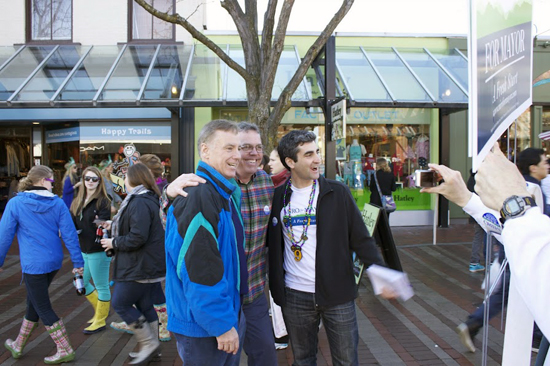
Photo by Nick Rivers: Former Governor Howard Dean, left, joins Miro Weinberger, right, during Sunday's Mardi Gras celebration in Burlington.
According to the Vermont Secretary of State’s unofficial results, Romney so far has received just under 39 percent of the votes gathered. Ron Paul is in second with around 25 percent of the votes, with Rick Santorum following close behind at 23 percent. Newt Gingrich trails in last place with less than nine percent of the votes. President Barack Obama won over 98 percent of the votes gathered for the Democratic primary for his re-election bid.
The city of Burlington also elected a new mayor on Tuesday. According to the unofficial results gathered by the city of Burlington, Democrat Miro Weinberger won handily with over 57 percent of the votes. Republican Kurt Wright came in second with roughly 37 percent. This was Wright’s third failed attempt to be Burlington’s mayor. Independent Wanda Wines gathered five percent of the votes.
Wards one through seven have all reportedly selected their councilors as well. Ed Adrian won an uncontested bid in Ward One. Max Tracey won with just under 63 percent of the votes for Ward Two. Rachel Siegel leads in a four-way race with just under 59 percent in Ward Three. Bryan Aubin leads with 53 percent of the vote to E. Brigss Kentworthy 47 percent in Ward Four. Ward Five shows William Mason ahead with 72 percent of the votes. Karen Paul, also running uncontested, has 98 percent of the votes in Ward Six. And finally in Ward Seven, Paul Decelles leads Tom Ayers by a margin of 52 percent to 47 percent.
The City of Montpelier also has a new mayor. Attorney John Hollar won an uncontested race. Meanwhile businessman Thierry Guerlain beat incumbent Nancy Sherman. And in ballot items that generated statewide interest, the capital city rejected both local option tax questions. Voters were asked to raise on cent on the sales and rooms, meals and alcohol taxes, but rejected both. The local business community had opposed both items. Most of the major retail centers in Vermont, including Burlington and the big box havens in Williston and South Burlington, have such local option taxes, which add 1 percent to the existing taxes. Williston initially rejected the idea, but voters eventually voted it in.
Montpelier results
Mayor - John Hollar (unopposed)
City Council - Thierry Guerlain 574, Nancy Sherman 371
Alan Weiss and Andy Hooper were unopposed and re-elected
School Board - Charles Phillips re-elected and Jennifer CahillBean elected (th unopposed)
City Clerk - John Odum 1204, Mike Marinelli1086
City Budget - Passed 1775-763
School Budget - Passed 1756-819
Recreation Budget - Passed 1934-619
$870,000 Infrastructure Bond - Passed 1826-700
Local Options Sales Tax - Failed 827-1739
Local Options Rooms, Meals &Alchohol Tax - Failed 1197-1376
City Charter Amendment for petition requirement- Passed 1329-1079
All other money articles on the ballot passed by wide margins.
Results also came in that voters in 23 towns throughout the state voted for an amendment to overturn the Citizens United versus Federal Elections Commission decision of 2010 and thereby place limits on corporate campaign spending. As many as 60 towns could cast votes by this evening on the decision that gave First Amendment protection to corporations by saying that government could not restrict political spending by corporations or unions. The decision allows corporations to give unlimited amounts of donations to political actions committees, known as Super PACs, but not directly to candidates. These Super PACs are not run in coordination with the candidates, and usually spend the donations on negative advertising of opposing candidates.
Vermont Senator Bernie Sanders is an outspoken opponent of the Citizens United decision, and has introduced legislation in the Senate to limit campaign spending. The proposal is called the Saving American Democracy Amendment. Sanders praised results to overturn the decision.