

by Nat Rudarakanchana vtdigger.org State economists Thomas Kavet and Jeffrey Carr have downgraded their state tax revenue forecast, projecting an $11 million reduction for fiscal year 2013.
The two economists told the Emergency Board on Friday that state revenues would be about $20 million less in fiscal year 2014, than they had originally forecast. The reductions cut across the key general, transportation, and education funds. The general fund generated $1.197 billion in available tax revenues in FY 2012; transportation contributed $222 million, and education $162 million. The joint projections respectively for FY2013 are $1.260 billion, $232.4 million and $168.6 million. For FY2014, they are $1.331 billion, $239.3 million and $180.5 million.
‘We were watching the economy carefully and closely, but it does seem with the downshift in the macro economy, there’s concern there’ll be a little less revenue,’said Kavet at the public hearing, prefacing this by describing the revenue in fiscal year 2012 as ‘generally pretty good.’
The two economists submitted separate reports to the board which agreed on most fundamentals. Kavet works for the Legislature and Carr for the Shumlin administration.
Kavet’s report attributed the less optimistic economic environment to ‘political dysfunction in both Washington and Brussels (European Union),’and accompanying policy inaction. Uncertainty surrounding European debt problems is a key factor here, as is the so-called potential future ‘‘fiscal cliff’in Washington, which refers to politically paralyzed fiscal policy and several impending laws slated to come into effect simultaneously in 2013.
But Kavet added that Vermont’s real estate market is bottoming out, seeing ‘small gains,’and that this will eventually mean more construction jobs. Vermont home prices increased in the first quarter of 2012, a positive feature, especially given the fact that no other Northeastern states reported rising home prices. SEE RELATED STORY
Still, he said: ‘It’s hard to imagine that we’re going to have the kind of economic turnaround that we were hoping was going to come in [fiscal year] 13, six months ago, which now doesn’t look like it’s coming until we get into [fiscal years] 14 and 15.’
But Governor Peter Shumlin, a member of the Emergency Board, wanted to remind the audience that Vermont’s financial situation is strong given the context of the recent economic recession.
Tom Kavet, economist for the Vermont Legislature, speaks at an Emergency Board meeting on July 20, 2012. VTD Photo/Taylor Dobbs
‘I do think that our ability to balance budgets in Vermont, to pay our bills, to maintain our extraordinary bond rating, and to be fiscally smart, not to spend money we don’t have, is paying off,’said Shumlin. He reported that other governors at a National Governors Association last weekend had complimented him on the state of Vermont’s finances.
But Shumlin also conceded that, ‘perhaps, projections weren’t as exuberant as what we had all hoped.’
The two reports, which contain hundreds of data points, were produced respectively by Economic & Policy Resources Inc., based in Williston, and by Kavet, Rockler & Associates, LLC, based in Williamstown.
Economist Jeffrey Carr concluded this part of the public meeting with: ‘Basically, we are continuing to increase our revenues year over year. Our growth isn’t at our earlier projections, but we’re continuing on a positive trajectory, and that’s good news.’
Jeff Carr, in an interview with Vermont Business Magazine immediately following his presentation to the E-Board, said that the ‘fiscal cliff’that the federal government is facing at the end of the year needs to be dealt with. He said that while inaction will on paper (see chart) reduce the deficit, it will have a profound deleterious effect on the economy. The cliff is the sunset of the Bush tax cuts and the automatic spending cuts on federal programs.
Congress and the president will need to do something on both tax policy and spending, Carr said. He said the spending cuts do not have to be severe and the tax increase does not have to be profound, but the US government must do something to at least ‘bend the curve’and show businesses and consumers that it is capable of doing something, thus restoring some level of confidence.
Carr said Congress should not raise taxes on anyone making less than $1 million a year because so many small business earners have their business earnings tied into their personal income taxes. He said that the deficit is not as severe as it may appear and as a percentage of GDP it is smaller than it was during the Reagan years. He said if Congress does nothing, the automatic cuts in the defense budget alone will be $600 billion.
Other items heard at the Emergency Board meeting included the Vermont Economic Progress Council’s request to exceed a $10 million spending cap on employment growth incentives, as well as a Medicaid spending and caseload report.
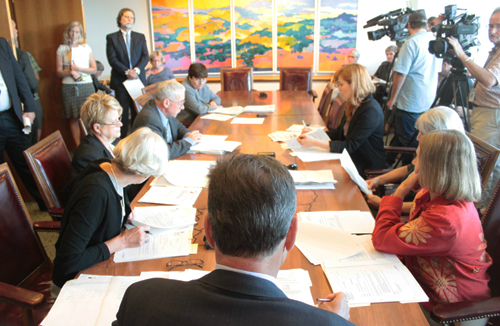
July 24, 2012 vtdigger.orgTimothy McQuiston of Vermont Business Magazine contributed to this report. Top Photo by vtdigger:Members of the Emergency Board convene on July 20, 2012. Governor Shumlin is in the foreground.