

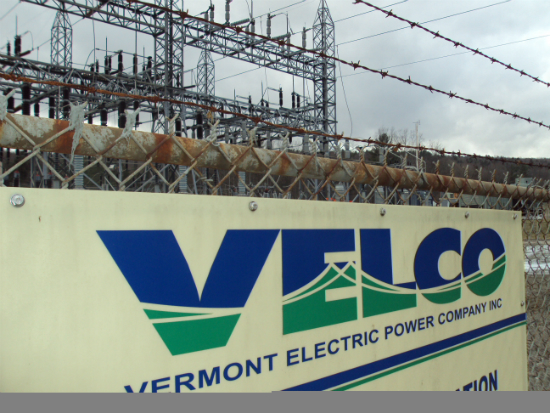
In testimony on the proposed merger of Green Mountain Power and Central Vermont Public Service submitted Friday to the Vermont Public Service Board, Vermont Electric Power Company President and CEO Chris Dutton pointed to VELCO’s over 50-year track record of the electric transmission company’s reliable service and ratepayer savings in urging the Board to protect what works and not jeopardize the company’s ability to continue to provide these public benefits.
‘There is almost universal agreement that VELCO performs very well and has saved Vermont ratepayers millions of dollars," Dutton said. The company has maintained a very strong credit rating even as it has to secure funding for an exponential growth in assets from roughly $120 million in 2005 to approximately $800 million at the end of 2011. With $500 million in additional capital construction expected over the next five years, the integrity and stability of VELCO’s billion dollar public service company structure and governance must be protected. We can’t afford to experiment with grid reliability.’
VELCO was founded as a for-profit, public service company in 1956 to serve as Vermont’s state-wide electric transmission company. Vermont’s local distribution utilities own the company which is headquartered in Rutland with over 150 employees and is subject to state, federal and regional regulation and control.
Dutton’s testimony responds, in part, to the recommendations contained in testimony filed January 10th by Professor Michael Dworkin, a witness in this case for the Vermont Department of Public Service.
Noted Dutton: ‘Imposing dramatic governance changes as recommended by Professor Dworkin, such as requiring VELCO to reserve seats on its board for political appointees chosen through a new, complicated process involving the Governor, legislature and a to-be-formed ‘State Transmission Nominations Board’, would put at risk our ability to continue to deliver benefits to ratepayers and maintain system reliability. He added, ‘This proposal completely disregards the existing regulatory protections that have long ensured that the state’s transmission system is operated in the interests of the general good of the State.’
Bringing his comments on Professor Dworkin’s testimony to a close, Dutton concluded: ‘If adopted, the Professor’s recommendations would render VELCO’s governance more political, complex and uncertain, and would almost certainly affect the company’s ability to attract low-cost capital to support required grid improvements in the near and long-term. That translates into increased costs for consumers.’
In contrast, Dutton offered measured support for the VELCO governance proposals offered by GMP and CVPS in their September 2, 2011, joint petition: ‘I do not think the Petitioners’ proposal will meaningfully impact VELCO’s management or operations nor do I expect a change in how the VELCO Board of Directors operates or exercises its responsibilities. Three key attributes of their proposal, in my view, are that it: insures VELCO will continue to lack a single dominating shareholder able to unilaterally exercise control over the company; preserves the beneficial role of independent directors; and leaves governance in the hands of the owners of the company. It’s not the only way to address the perception that the combined company could exercise control of VELCO in a manner detrimental to Vermont but it is workable.’
In addition to Dutton, VELCO also submitted testimony from its expert witness Nora Mead Brownell, former commissioner of the Federal Energy Regulatory Commission and Pennsylvania Public Utility Commission.
A decision on the merger (Docket 7770) is expected by the Vermont Public Service Board in June 2012.