

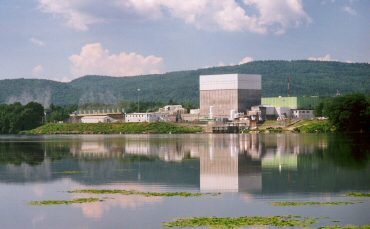
The State of Vermont cannot force the Vermont Yankee nuclear plant to close on March 21, 2012. In a ruling released late Thursday afternoon, United States District JudgeJ Garvan Murtha ruled in favor of VY owner Entergy over the state, and in particular Governor Peter Shumlin. Murtha order said the state has no right to preempt the Atomic Energy Act and stand in the way of Entergy seeking a certificate of Public Good to extend the license of the plant for 20 years, nor could the state require Entergyt to seek additional state approval to store spent fuel on-site after March 21, 2012, nor could it require Entergy to sell electricity to Vermont below market rates.
While Governor Peter Shumlin vowed to appeal the 102-page ruling, Entergy released a statement saying: "We’re pleased with the decision, which Judge Murtha issued after a thorough review of the facts and the law. The ruling is good news for our 600 employees, the environment and New England residents and industries that depend on clean, affordable, reliable power provided by Vermont Yankee."
Shumlin stated: "I am very disappointed in today’s ruling from the federal court. Entergy has not been a trustworthy partner with the state of Vermont. Vermont Yankee needed legislative approval 40 years ago. The plant received approval to operate until March, 2012. I continue to believe that it is in Vermont's best interest to retire the plant. I will await the Attorney General’s review of the decision to comment further on whether the state will appeal."
Vermont's case hinged on its contention that the state wanted the plant closed on non-safety issues, while agreeing that only the federal government had jurisdiction over nuclear plant safety. The state also contended that Entergy had agreed that the state indeed had such authority, when it bought the plant in 2002. The state also contended that Entergy needed state approval to continue to store spent fuel in dry casks on-site after March 21, 2012.
The spent fuel is a key issue because the plant is already storing spent fuel on-site outside of the containment. If Vermont Yankee were not allowed to do so, it would have to shut down because the spent-fuel pool is filled and there is no other site outside of the Vernon site approved to store it.
Murtha also denied the state's contention that Entergy, when it bought the plant in 2002, had agreed to let the state have jurisdiction over federal preemption. Murtha ruled that Entergy had agreed only in the context of the Vermont Public Service Board, which would ultimately rule on the issuance of a Certificate of Public Good.
"Defendants fail to demonstrate Entergy expressly waived the preemption claims raisedin this suit," Murtha wrote, "because the 2002 MOU waiver was very limited, waiving only a preemption claimchallenging ‘the jurisdiction of the Board’ to grant or deny a CPG for continued operation. (Id.emphasis added). Defendants assert interpretation of the 2002 MOU is governed by Vermontlaw. See id. at 7, ¶ 16(1).
"Entergy’s suit does not maintain that the resting of jurisdiction in the Board to grant ordeny a CPG for continued operation is preempted. The 2002 MOU did not expressly waiveexclusive federal jurisdiction over radiological safety and public health, or waive any and allpreemption challenges to state law, or amount to a general promise not to sue.(Case 1:11-cv-00099-jgm Document 181 Filed 01/19/12 Page 94 of 10295)
"Even if the 2002 MOU had contained a broader waiver that encompassed the claimsEntergy brings here, this Court doubts that, in the unique circumstances presented in this case,Defendants could 'thereby obtain any ability to regulate in th[e] areas . . . Congress has reserved ... to itself'."
In other words, any agreement between the state and Entergy did not matter; neither the state Legislature nor Entergy have right to claim authority over federal preemption.
Murtha, in effect, rejected all of the state's claims and found for the plaintiff Entergy. Along with declaring that Vermont cannot preempt the Atomic Energy Act, he orderedthe following permanent injunctiverelief:
"1. Defendants are permanently enjoined, as preempted under the AtomicEnergy Act, from enforcing Act 160 by bringing an enforcement action, ortaking other action, to compel Vermont Yankee to shut down after March 21,2012 because it failed to obtain legislative approval (under the provisions of Act160) for a Certificate of Public Good for continued operation, as requested byPlaintiffs’ pending petition in Public Service Board Docket No. 7440, or in anysubsequent petition. (Case 1:11-cv-0099-jgm Document 181 Filed 01/19/12 Page 100 of 102101)
"2. Defendants are permanently enjoined, as preempted under the AtomicEnergy Act, from enforcing the single provision within section 6522(c)(4) oftitle 10, enacted as part of Act 74, stating ‘Storage of spent nuclear fuel derivedfrom the operation of Vermont Yankee after March 21, 2012 shall require theapproval of the general assembly under this chapter,’ by bringing anenforcement action, or taking other action, to compel Vermont Yankee to shutdown or to prevent storage of spent nuclear fuel after March 21, 2012 because itfailed to obtain legislative approval (under the same preempted provision) for aCertificate of Public Good for storage of spent fuel, as requested by Plaintiffs’pending petition in Public Service Board Docket No. 7440, or in any subsequentpetition.
"3. Defendants are permanently enjoined, as prohibited by the dormantCommerce Clause, from conditioning the issuance of a Certificate of PublicGood for continued operation on the existence of a below-wholesale-marketpower purchase agreement between Plaintiffs and Vermont utilities, or requiringVermont Yankee to sell power to Vermont utilities at rates below those availableto wholesale customers in other states."
Senator Bernie Sanders released the following statement following the ruling: ‘The court today has made a decision that is, in my view, wrong on the merits and ripe for appeal. I believe the law is very clear, and that states have the right to reject nuclear power for economic and other non-safety reasons.
Brad Ferland, President of the Vermont Energy Partnership issued the following statement: ‘This is an important and well-reasoned decision that merits the attention of all policy makers. Vermont Yankee is a safe facility which provides important economic and environmental benefits to Vermont. The judge’s decision is good news for Vermont.
‘We hope today’s ruling will be the basis for fresh thinking and reflection on the very positive role the plant can and should play in the state’s future. We encourage policy makers to pursue this course instead of protracted, expensive, divisive legal battles.’
The Vermont Energy Partnership (www.vtep.org) is a diverse group of more than 90 business, labor, and community leaders committed to finding clean, affordable and reliable electricity solutions. Entergy is a member of the Vermont Energy Partnership.
US Senator Bernie Sanders said: ‘It is inconceivable to me that Entergy can force Vermont to allow continued operation of Vermont Yankee, an aging and problem-plagued nuclear plant, when the people of Vermont want to move aggressively to energy efficiency and sustainable energy.
‘Vermont’s laws, which Entergy agreed to abide by when it bought Vermont Yankee, require that Entergy receive a new certificate of public good in order to operate beyond March of 2012. In a very strong 26-4 bipartisan vote, the Vermont Senate voted against allowing Vermont Yankee to receive that certificate. They believed, and I believe, that the continuation of Vermont Yankee in our state is not in the best interest of Vermont.
"Allowing Entergy to evade laws they agreed to abide by sets a horrendous precedent which should not be allowed to stand. The state of Vermont and other states must have the right to determine their own energy future.’
US Representative Peter Welch said:‘This is a major setback for Vermont and for all states with nuclear power plants. It simply defies common sense that a state cannot have a say in its energy future. This issue was settled in Vermont until Entergy reneged on its agreement to give Vermonters a voice in relicensing Vermont Yankee. I intend to work closely with Governor Shumlin and Senators Leahy and Sanders on an appropriate response to Entergy's misguided decision to railroad the relicensing of this plant.’
Jeffery Wimette,Business Manager, IBEW Local #300, the electricians union that works with Vermont Yankee, said:‘The news of Judge Murtha’s decision rings for truth and justice throughout Vermont; the bells are ringing in Windham County tonight. Hundreds of hard working, skilled and dedicated employees are now able to continue working and keep their jobs to provide for their families. The IBEW Local #300 and other highly skilled employees who work at Vermont Yankee place the highest emphasis on safety to ensure the facility is safe for all who work and live in the area. If members of the IBEW had any doubt about VT Yankee’s safety, they would be the first to blow the whistle. I congratulate the employees of VT Yankee for standing tall and keeping their faith over the past two years. The law has prevailed, not the law makers.’
Speaker of the Vermont House Shap Smith and Senate President Pro-Tem John Campbell issued the following statement:‘Under this decision, Vermont Yankee remains required to have a Certificate of Public Good issued by the Public Service Board in order to operate. We expect the Public Service Board will consider the issue of continuing operation in its pending docket. The state will look closely at the decision to see what boundaries the Court has set for the issuance of a Certificate of Public Good and will hear from all parties to ensure that the best interests ofVermontand its citizens are represented in this process.’
AttachmentSize
Vermont_Yankee_Murtha-Decision_Jan_19_2012.pdf389.23 KB